For a franchise that dominated the box office for years, you sure don't hear much about the Hangover movies these days. What, no reboot? But of course, Hollywood has been rebooting that series for years: change the leads, preferably in a way that makes their one crazy night (or day) seem even more outlandish (20-something white guys going on a bender being pretty much the most predictable storyline ever), and away you go.
Here's the good news: Good Boys is actually good. It turns out the big twist you need to breath new life into this genre isn't so much respect for everyone - which made the otherwise entertaining Booksmart feel just a little cloying and preachy at times - as it is a solid comedy contrast. Here it's a trio of basically sweet pre-teen boys trying to navigate a NSFW world; the jokes don't exactly write themselves, but it's a good start.
Max (Jacob Tremblay) is a nice kid who's just discovered girls; Thor (Brady Noon) is worried he's getting too old for musical theatre; and Lucas (Keith L. Williams) is probably just a little too keen on following rules. Together they're the "beanbag boys", a gang nobody cares about who are probably - if they were paying attention - just about to grow apart.
But not just yet. When Max accidentally trashes his dad's treasured drone ("it's not a toy - it's for work"), the trio band together to raise the cash for a replacement. Fortunately for comedy but unfortunately for them, their schemes rapidly spiral out of control; selling a sex doll is one of their more sedate antics, especially once they get tangled up with a pair of older girls (Molly Gordon and Midori Francis) who just want their drugs back so they can go to a concert.
The stakes are kept small - their big road trip is a few miles to a nearby mall, and crossing a highway is the big action scene - and the crudity promised by the trailers is relatively sedate (and made a lot funnier once the trio's essentially nice natures are established). The main performances make this work; they're all plausible as slightly clueless kids and charasmatic in their own right, which goes a long way towards making this charmingly funny rather than annoyingly blunt.
By having the kids at the age where they basically still want to do the right thing, this manages to tap into an essential sweetness that makes the lowbrow jokes (hey look, they're mispronouncing "anal") funnier than you might expect. It'd be nice to think this is the natural end point for this kind of comedy (unless someone figures out a way to stage one with babies), and if it is, it's definitely going out on a high.
Not that kind of high though; one of the best running gags in the film is the way these kids earnestly say no to drugs even when drugs aren't an option. Which for this kind of film has to be some kind of a first.
- Anthony Morris
Wednesday, 18 September 2019
Friday, 13 September 2019
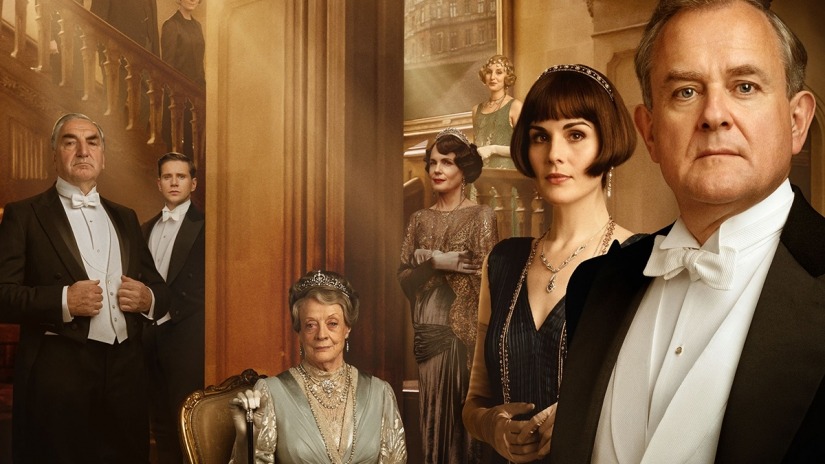
Review: Downton Abbey
Downton Abbey is the kind of film that's usually described as "a chance to catch up with your favourite characters". One problem: I've never watched the television show this movie is based on. Turns out, that was actually a plus: being aimed entirely at fans, this film had zero interest in explaining who anyone was or what their relationships were to everyone else, which made it - on one level at least - a lot more realistic to watch. These were people in the middle of living their lives, not characters that required clumsy exposition to manouver them into a place where the story could begin.
Also; not a lot of story here. The year is 1927, which realistically is about as late as it could be and still be a fairy tale setting; the Great Depression is still a year or two away, the grim 30s come after that and then there's a war and a Labour government who'll establish death duties directly designed to financially cripple these toffs. But for now, the good times are still rolling along, and who's that on the horizon? Why, it's King George and company, announcing they'll be stopping off for the night as part of a regional tour designed to forestall revolution... uh, I mean, visit their subjects.
As much of this extremely lightweight but reasonably entertaining film exists merely to let you know that various characters are still alive, the numerous subplots are extremely basic: one of the well-off sisters is worried about running the estate but eventually decides to muddle on; one of the servants is doubtful about her engagement but then reaffirms her love once she realises her husband-to-be is a mindlessly violent thug who wants to smash things when he doesn't get his way (THIS IS NOT A JOKE). As long as everything looks fabulous, who cares? And things definitely do look fab: the dresses alone pretty much justify the existence of this film, and there are also some old cars puttering about. Sadly no biplanes, which does feel like an oversight.
Not knowing anyone meant that I had no idea who I was meant to care about, but eventually I latched onto Tom Branson (Allen Leech), a Irish car salesman who I worked out was once married to someone once well-off but now dead and who seemed remarkably fine with having their child brought up by the toffs away from him (the kids get maybe one and a half moments in the film, and even then they're observed from a distance being tended to by nannies; their parents are really going to feel bad when the kids grow up as complete strangers and then die fighting Hitler).
Anyway, Tom was great, being loved by both Royals and people wanting to kill Royals, wandering around dispensing advice that basically boiled down to "it's best to just put up with shit". Which I guess is fair enough when you've already married one wealthy stunner and look likely to end up hooking up with another, but it still seems a bit crap as advice to give to someone trapped in a loveless marriage or wanting to smash the British Empire, which after all did invent the concentration camp and were the first people to use poison gas on civilians. Still, the king can ride a horse, which is pretty impressive at his age.
The closest this gets to being about anything is when a gay character stumbles into a roaring 20s gay bar - well, gay barn - which is then promptly raided by the police, who are surprisingly non-violent but presumably this being the UK they're well aware of the possibility of snagging a royal or two by mistake. Even this is relatively quickly sorted out and the whole thing ends on a "maybe they'll accept us one day" note, which is nice enough but seems a bit odd for a movie that otherwise is entirely about the naked desire to thwart all forms of social progress so well-off toffs can continue to hold fancy balls indefinitely.
Also, Maggie Smith never tells a servant to "get fucked", which was a personal dissapointment.
- Anthony Morris
Also; not a lot of story here. The year is 1927, which realistically is about as late as it could be and still be a fairy tale setting; the Great Depression is still a year or two away, the grim 30s come after that and then there's a war and a Labour government who'll establish death duties directly designed to financially cripple these toffs. But for now, the good times are still rolling along, and who's that on the horizon? Why, it's King George and company, announcing they'll be stopping off for the night as part of a regional tour designed to forestall revolution... uh, I mean, visit their subjects.
As much of this extremely lightweight but reasonably entertaining film exists merely to let you know that various characters are still alive, the numerous subplots are extremely basic: one of the well-off sisters is worried about running the estate but eventually decides to muddle on; one of the servants is doubtful about her engagement but then reaffirms her love once she realises her husband-to-be is a mindlessly violent thug who wants to smash things when he doesn't get his way (THIS IS NOT A JOKE). As long as everything looks fabulous, who cares? And things definitely do look fab: the dresses alone pretty much justify the existence of this film, and there are also some old cars puttering about. Sadly no biplanes, which does feel like an oversight.
Not knowing anyone meant that I had no idea who I was meant to care about, but eventually I latched onto Tom Branson (Allen Leech), a Irish car salesman who I worked out was once married to someone once well-off but now dead and who seemed remarkably fine with having their child brought up by the toffs away from him (the kids get maybe one and a half moments in the film, and even then they're observed from a distance being tended to by nannies; their parents are really going to feel bad when the kids grow up as complete strangers and then die fighting Hitler).
Anyway, Tom was great, being loved by both Royals and people wanting to kill Royals, wandering around dispensing advice that basically boiled down to "it's best to just put up with shit". Which I guess is fair enough when you've already married one wealthy stunner and look likely to end up hooking up with another, but it still seems a bit crap as advice to give to someone trapped in a loveless marriage or wanting to smash the British Empire, which after all did invent the concentration camp and were the first people to use poison gas on civilians. Still, the king can ride a horse, which is pretty impressive at his age.
The closest this gets to being about anything is when a gay character stumbles into a roaring 20s gay bar - well, gay barn - which is then promptly raided by the police, who are surprisingly non-violent but presumably this being the UK they're well aware of the possibility of snagging a royal or two by mistake. Even this is relatively quickly sorted out and the whole thing ends on a "maybe they'll accept us one day" note, which is nice enough but seems a bit odd for a movie that otherwise is entirely about the naked desire to thwart all forms of social progress so well-off toffs can continue to hold fancy balls indefinitely.
Also, Maggie Smith never tells a servant to "get fucked", which was a personal dissapointment.
- Anthony Morris
Thursday, 5 September 2019
Review: It Chapter 2
Splitting
Stephen King's novel It into two films always made just enough sense to seem a
reasonable move. The book is massive, with a huge cast and a timeline that
stretches at least 27 years (if you cut out all the history stuff; if you
don't, we're talking a century or more). Obviously if you wanted to tell the
story right, you were going to need more time than the bladders of movie-goers
would allow; with the cast already going to be played both as kids and
world-weary grown-ups, splitting the timeline up into two movies, well... made
just enough sense to seem a reasonable move.
Unfortunately
for anyone hoping King's big statement on horror would turn into a movie with
the same kind of impact and resonance, much of what makes King's novel work is
the way that it is in large part about the horror of a): being a kid and b):
being a grown-up dragged back into the world of being a kid. For this to work,
you really need the two playing out side by side; you split them up, and you just
have a bunch of grown-ups being startled by all kinds of silly shit.
Also, much
of the tension in the novel comes from the kids and grown-ups story lines
playing out side by side; as you read the novel you know the kids somehow managed to fend off
Pennywise the Clown (Bill Skarsgard), but you have no idea how - and part of the horror of the
small town of Derry is that once you grow up (and especially when you leave),
you forget what you faced as a child. Is the price required to defeat Pennywise
something that as adults they'll find too costly to bear? Is it possible that
they've lost the childish belief that enabled them to win and now they're all
doomed? Let's find out!
Oh wait,
we saw all that already in the first movie. Which goes a long way towards making this one of the least scary
horror films in recent memory. Not from lack of trying, mind you: when the now
grown-up Losers from the first film are summoned back to Derry by Librarian
Mike Hanlon (Isaiah Mustafa), the only one who’s stayed in town, much of their
time is spent split up and facing their own fears in an attempt to figure out
what they’ve lost.
Unfortunately,
much of what they’ve lost in the transition from page to screen is their
characters. Bill Denbrough (James McAvoy) is a best-selling horror writer
whose sole defining feature is that he’s bad at endings; Beverly Marsh (Jessica
Chastain) escaped her abusive dad for an abusive husband who she simply leaves and never mentions again (the idea that the grown-up Losers are just repeating their childhoods would have more impact if we ever got any real sense of what their actual adult lives are like).
Richie
Tozier (Bill Hader) is a snarky abuse comedian – much of the praise for Hader’s
performance (which is legitimately good) comes from the fact that he’s literally the only
adult Loser with a distinct personality – while the sweet but chunky Ben Hanscom (Jay
Ryan) is now a studly architect, jittery hypochondriac Eddie Kaspbrak (James
Ransone) is a jittery risk assessor and thoughtful Stan Uris (Andy Bean) probably
shouldn’t have thought quite so much about what returning to Derry would be
like.
In the novel, a lot of the horror in the adult sections comes from the way Pennywise - who can't directly kill adults, although maybe he can - manipulates the mundane horrors of the adult world to serve him. Here that's reduced to a brief and forgettable subplot involving the return of one of their childhood bullies, mullet still intact.
Then again, pretty much everything here is reduced to a brief subplot (the novel's most powerful idea, that Pennywise's centuries of evil have soaked into Derry and turned the whole town rotten, is all but ignored); every character has to get at least two scary encounters with Pennywise, and once you've got to fit in twelve jump-scare packed scenes and a big climax there just isn't much room left for anything else even when you're pushing three hours.
That said, while it may not hang together well as a film It Chapter 2 does definitely have some memorable moments; the film's most frightening scenes don't involve the Losers at all. And Pennywise does get to pull off a few bizarrely surreal antics to remind audiences that he's meant to be an almost Lovecraftian avatar of unknowable evil, not some cannibal bozo.
But the split in structure does irreparable damage to the story, and the numerous flashback scenes featuring the younger cast don't help (none of them are scary for starters, which constantly defuses what little tension the film builds up). Stephen King's novel is notorious for being an overstuffed mess; somehow, this film manages to outdo him.
- Anthony Morris
Friday, 30 August 2019
Review: Dragged Across Concrete
Henry Johns
(Tory Kittles) is fresh out of prison and looking for a way to make a little
money. Old friend Biscuit (Michael Jai White) just might have the job for him,
but it doesn’t take long for the pair to realise they’re getting in over their
head - working with a couple of stone cold killers who never take their masks off tends to give that impression.
Meanwhile, old-fashioned hard-nosed cops Brett Ridgeman (Mel Gibson) and
Anthony Lurasetti (Vince Vaughn) have been caught on camera handing out some
street justice and are facing suspension – something neither of them can afford. So now they're looking for a way to make a little money on the side too. This is not good news for anybody.
Writer-director S. Craig Zahler (Bone Tomahawk, Brawl
in Cell Block 99) tells a sprawling (it’s over two and a half hours) crime
saga where the sprawl is much of the point: just spending time with these
dubious characters is much of the appeal of this film, though when the plot
does kick in it kicks hard. And scene-by-scene this is pretty much all good - even a diversion focusing on a bank staffer (Jennifer Carpenter) who doesn't want to go back to work and be separated from her baby.
Gibson and Vaughn are the acting powerhouses here,
which skews the film a little; the story as written gives roughly equal time to both sides but
the white guys are the faces you’ll remember. They’re also unlikable in ways that are
unfashionable today, and the film gives their racial grievances just enough
grounding to make it tricky to tell whether the film is on their side or not.
Which is probably the point,
as this constantly strives for (and often reaches) the kind of real-world grit
most crime films only gesture at. It's not exactly the kind of film where anything could happen, though it has its share of shocks; rather, it's coming from a direction a lot of crime films (and films in general) today won't take, where the characters exist just as flawed human beings rather than symbols of certain moral or social standpoints.
This is a film that has no real interest in right or wrong, and never at any point indicates that anybody deserves anything that comes to them. Bad people might prosper; good people could come to sticky ends. At a time when movie morality seems stuck at the brightly-coloured superhero level, it's a defiantly grown-up view of the world.
- Anthony Morris
-->
Thursday, 29 August 2019
Review: The Nightingale
The tone
of convict movies can usually be guessed by their location; the further from
Sydney you get, the grimmer they are. And by the time you hit Van Diemen’s
Land, you know you’re in serious trouble; if anyone ever makes a convict movie
set further south than Hobart, they'll basically just be throwing buckets of
blood at the camera from scene one.
And so it
proves with The Nightingale, a bracing rape-revenge tale that’s often hard to
take even for seasoned genre fans. The year is 1825, and former convict Clare
(Aisling Franciosi) is being regularly raped by Lieutenant Hawkins (Sam
Claflin), leader of the local military garrison in the southern wilds of Van
Diemen's Land. When her husband Aidan (Michael Sheasby) finally speaks out
about the injustice of what's going on, the results are bad news all around.
Hawkins,
his 2IC sergeant Ruse (Damon Herriman) and a small group of men head north
through the wilderness; Clare enlists the help of tracker Billy (Baykali
Ganambarr) to help her catch them. What starts out as a chase soon develops
into something a bit more complicated, as various agendas clash and revenge
turns out to be a bit messier than initially thought.
At first
this film – the second from Jennifer Kent, writer-director of The Babadook – is
both brutal and relatively straightforward. It’s not until the third act that
things start to lose their focus, which muddies the waters in ways that aren’t
always to the film’s benefit. For a film about a chase through the wilderness,
there sure do seem to be a lot of people hanging around the bush; when the
isolation of some of the characters is presented as a death threat later on,
it's hard to take seriously (and rightly so; they get out of it relatively
easily).
The much
discussed brutality of the multiple rape scenes is in keeping with the film’s
setting, and the characters are nuanced enough that this never feels purely
exploitative. Unfortunately, what exactly is being said here never comes clear
either. It wants to be bigger than mere revenge at times; at others it's fully
behind bloodshed, but only for some characters. It never comes apart, but the
ever-widening scope of the film occasionally seems to spin the story beyond
Kent's control; this film is at its sharpest when its at its most shocking.
- Anthony
Morris
Thursday, 15 August 2019
Out now: Shazam!
Remember
when superheroes were for kids? Eh, probably not: Tim Burton's Batman back in
1989 pretty much sunk that boat, and since then taking things way too seriously
has been the hallmark of the grown-up superhero movie. How weird is it that
we're getting a Joker movie that nobody under the age of 25 should see? Creepy
murder clowns: they're not just for kids anymore.
All of
which is kind of strange, because the one thing superheroes really can do
better than just about any other genre is speak to the youth. The phrase
"adolescent power fantasies" used to be thrown around a lot in
comic-book circles when comics were trying to get out from under the influence
of superheroes; the difficult thing today is explaining exactly why it was seen
as a bad thing when it leads to a movie like Shazam!.
When
orphan 13 year-old Billy Batson (Asher Angel) is given super-powers by a wizard
(Djimon Hounsou) to defeat the running amok Seven Deadly Sins and their human
puppet Dr Sivana (Mark Strong), he does what any teen would do: uses his
all-grown-up superhuman form (Zachary Levi) to buy beer, get out of school, and
become a YouTube sensation by doing nutty stunts.
This is
the DC universe in kid-friendly mode, ramping up the silliness and keeping the
tone light without depriving audiences of superhero thrills. To be fair, the
hero formerly known as Captain Marvel is definitely one of their sillier
characters, and with a Mr Mind cameo - look him up - this is definitely
steering into that side of the superhero world.
There's a
lot of comedy here, but beyond that this as much about family and friendship –
Billy’s growing bond with fellow group home resident Freddy Freeman (Jack Dylan
Grazer) is the surprisingly tender heart of this film – as it is about running
around punching bad guys. Levi gives a note-perfect performance as a kid
gleefully enjoying his superhero powers the most when he’s using them to do the
least, while Grazer rapidly becomes a perfect sidekick and Strong... well, he
does what he can with an underdrawn character.
Some of
the jokes aren’t the freshest, but even the old “let’s test your powers”
routines are fun to watch and when things start to get heartfelt this still has
a bunch of strange but fitting cards to play. This really does get just about
everything right, and the result is easily the strongest DC universe film since
Wonder Woman. Shazam! is all-ages fun that’s all-ages funny; with darker
superhero films looming on the horizon, it’s the comic relief you didn’t know
you needed.
- Anthony
Morris
Friday, 9 August 2019
Review: Palm Beach
There’s a certain kind of film that feels like it’ll vanish from our
screens the second someone figures out how to make virtual reality really work. Gripping
stories and dramatic characters probably aren’t ever going to go away, but movies
where the whole point is that we get to spend time with nice people in fancy
locations – often with a bunch of delicious food being served – are the kind of virtual getaway that technology can only improve on. You probably wouldn't want to live through a Jack Reacher novel on the Star Trek holodeck, but one of those movies where you take a slow drive through the south of France? Beam me up, Scottie.
(yes, I know Scottie's Enterprise didn't have holodecks, they were introduced in Star Trek: The Next Generation, give me a break)
And so it proves to be with Palm Beach, a movie where a bunch of oldish folks go to a very nice
looking beach town, stay at a very fancy mansion, take a bit of a stroll around
the neighbourhood, soak up some rays, and just generally have a good old time relaxing in the sun. It doesn't quite feel like the Palm Beach Chamber of Commerce paid director Rachel Ward to film a commercial about the wonders of their little town - at least, not in the way that Any Questions For Ben felt like it was a commercial for Melbourne - but if there were a pile of brochures about purchasing beachside property outside the cinema when it was over you wouldn't be too surprised.
Okay, there is a bit of a story here too, as Frank (Bryan Brown), having made a mint from artist
representation (or selling t-shirts, it's a little unclear), has invited
his former band mates to his beach house for a weekend of chilling out. Actually, there’s a bit of four or five
stories early on, but a lot of plot threads between these old friends with
unfinished business are dropped or just fizzle out (it feels like there could
possibly be a three hour directors cut somewhere).
Unfortunately, some of the forgotten threads are the interesting ones. Richard E Grant's character is writing advertising jingles and won an award for basically ripping off the band's only hit single; he's also somewhat bitter that Frank is cashed up and he's still struggling. This side of things is quietly dropped; likewise, the fact that the band's original singer (and Frank's wife) died years ago is just thrown out there before sinking without trace. There is a family mystery that plays out involving Sam Neill's character, but it's literally the most obvious story here, and it goes all the obvious places.
(oh, and Frank tears down a neighbour's chimney because it's blocking his view, though his frustration with his impotence could be a factor as well)
Still, Brown, Neill, and Grant, along with Jacqueline McKenzie and Greta Scacchi (and others) make
for entertaining beachside company to hang out with. And really, that's the point of all this. These are all well-off people with minor problems at best, and the film really doesn't pretend otherwise. It'd probably be more offensive if it tried to tell a serious story around these characters; despite the occasional gloomy expression, with the views they're currently enjoying out over the Pacific they don't have a care in the world.
- Anthony Morris
-->
Subscribe to:
Posts (Atom)