Search This Blog

Friday, 11 February 2022

Review: Blacklight

Liam Neeson's last team-up with writer-director Mark Williams was the surprisingly sturdy Honest Thief, the kind of late-career Neeson thriller that stays firmly within the audience's comfort zone while providing just enough quirky character moments and decent action to make it an entertaining 90-odd minutes. Now the gang is back with Blacklight, which seems to promise more of the same but ends up reaching for something a little different.

Travis Block (Neeson) specialises in extracting FBI agents from undercover operations too hot to handle. He's been doing this for years off the books for Gabriel Robinson (Aidan Quinn), who's now the head of the FBI and the closest thing Block has to a friend. But he does have a family: his daughter Amanda (Claire van der Boom), who is more than a little wary of her often absent father, and a young granddaughter, who he's rapidly training to be as paranoid as he is.

Meanwhile, the actual story involves Dusty Crane (Taylor John Smith), an undercover agent who's had a severe attack of conscience after being involved in an operation that ended in the murder of a high profile politician. He's trying to tell his story to anyone who'll listen, which (as he's clearly a little unhinged) just means online journalist Mira Jones (Emmy Raver-Lampman). Now Block's latest job is to calm Crane down and bring him in without too many car chases through Melbourne's Southbank precinct pretending to be Washington DC.

While Neeson's presence suggests this will be yet another enjoyable opportunity for him to take out the trash, this is in fact a political thriller where Neeson's character spends much of the film playing second fiddle to the genre's traditional leads - the whistle-blower and the crusading journalist. He's given various bits of personal business to keep him occupied, and there are a handful of striking and well thought out action scenes, but at times this feels like he's been dropped into a story that really doesn't need him.

The flip side of this is that he's still the heart of the film, playing a character that's the most interesting thing on screen. Less may be more, but almost everything about Block feels like it deserved more screen time; a sequence towards the end where he panics over losing contact with his family is more memorable than the various generic threats to democracy discussed around it.

Part of the problem is that there's no mystery behind the conspiracy. We almost always know what's going on before Block does, so many of his early scenes are just waiting for him to get caught up. It's noticable that the few scenes that feature actual surprises - or just Block professionally doing his job - are easily the most effective here. 

Despite the at-times stylish direction and strong performances, too often the story in Blacklight gets in its own way: half as much going on (leaving more room for Block to electrocute the bad guys and train a pre-schooler to always count the exits) would have been twice as engaging.

- Anthony Morris

Thursday, 10 February 2022

Review: Death on the Nile

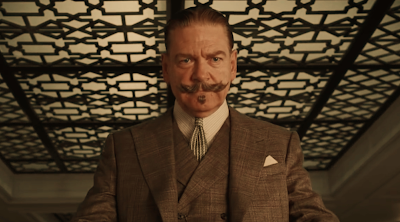
The title of Kenneth Branagh's second - and with Disney having left this on the shelves for well over a year, almost certainly last - Agatha Christie adaptation promises viewers two things. Unfortunately, here the Nile is only adequate at best, a mix of average CGI and the occasional cutaway to reed farmers or chomping crocodiles; Death, on the other hand, does more than its fair share of the heavy lifting.

Almost from the beginning, Christie's puzzlebox mysteries were scorned by fellow crime writers as bloodless things detached from reality. Branagh seems to have taken this criticism firmly on board, even as, close to a century later, the mystery genre continues to thrive on contrivance and disposable characters. A quirky, self-referential, post-modern take on the genre this is not.

Opening with a WWI sequence that's both a grim origin story for Poirot's mustache and the first sign that this is a tale where love is firmly entwined with death, things muddle around for a while in pre-WWII London and Egypt until Poirot's enjoyment of the Great Pyramids is interrupted by old chum Bouc (Tom Bateman), who drags him along to a fancy honeymoon party where it turns out Poirot knows the main players but not the combination they've settled down in.

Extremely wealthy heiress Linnet Ridgeway (Gal Gadot, charming and likable) has just wed hunky lunk Simon Doyle (Armie Hammer, entertainingly solid), who - last time we saw him - was dry humping Linnet's bestie Jacqueline (Emma Mackie, sympathetically tormented) on a London nightclub dancefloor. Now she's turned stalker, Linnet is understandably freaking out, and she asks Poirot to tag along in the hopes his private investigator skills can keep her safe.

Meanwhile, literally everyone else in the party has a reason to be a suspect if something dodgy were to happen while they're cruising the Nile. There's a disgruntled maid, a shady lawyer, a doctor still carrying a torch for Linnet, a couple of old biddies who either miss their former wealth or won't stop talking about how they gave it away, and on it goes.

It's not until the halfway mark that we actually get to the (first) murder on the Nile. That may be too long for mystery buffs, but the attempt to give the roster of suspects at least some life - and a few pre-murder scenes to allow the impressive cast to play their characters as actual people - will be appreciated by those who either know the outcome or guessed it the second the events leading to murder kick off.

Likewise, despite the 30s-era glamour and luxury, everyone here takes everything extremely seriously (even Russell Brand as the lovelorn doctor never cracks a smile). If you're on this film's wavelength and not just wishing you were watching Knives Out instead, Branagh's approach as director is clearly the right way to go. This story is lightweight fluff any way you look at it, a puzzle built around unlikely people and contrivances; pointing any of this out, even for an instant, would make the whole thing collapse.

No wonder then that Branagh's Poirot is - silly mustache aside - a man tormented by lost love, an OCD sufferer scared to let anyone in, trapped on a boat where people keep being murdered and he's powerless to stop it. 

Terrified by the way death follows him and yet only truly happy when staring at the Pyramids (which are, after all, just giant tombstones), the world's greatest detective is definitely the last person anyone should invite onto a pleasure cruise.

- Anthony Morris


Friday, 4 February 2022

Review: Moonfall

One of the classics of (literal) lunacy in paperback form is George H. Leonard's Someone Else is on Our Moon, a book based entirely on blurry photos of the moon's surface which the author has stared at for hours until he finally saw alien machines and hatches and loads of other cool stuff. That's not a joke: he actually advises his readers to do the same. There's a reason why the cover says "Startlingly Illustrated".

Presumably Roland Emmerich felt simply adapting this directly to the screen would have resulted in a film of limited appeal, as it would largely consist of the author harassing NASA scientists while arguing with fellow crackpots about exactly which moons in our solar system were actually alien spaceships ("all of them?"). Instead, Moonfall takes the basic idea of Leonard's book, bolts on a standard space disaster movie template, and drags things out for 130 minutes when 90 would have done just fine.

Ten years ago Brian Harper (Patrick Wilson) and Jo Fowler (Halle Berry) were happy astronauts on a space shuttle satellite repair mission when Things Went Wrong. A supporting character died, Harper was disgraced, and ten years later he's a earth-bound bum whose wife has left him for some rich dude (Michael Pena), his eldest son (Charlie Plummer) is a hot-rodding delinquent, and who really cares because the moon is about to crash into the Earth and kill us all.

While NASA deputy chief Fowler (who is now divorced but has a Chinese exchange student) is concerned about this top secret news, crackpot loser K.C. Houseman (John Bradley) has also figured out the moon is getting closer by using stolen telescope time to calculate stuff and not by looking at the moon and saying "looks bigger than usual". 

Nobody at NASA will take him seriously for the exact same reasons nobody took George H. Leonard seriously, and by the time we get to see a meeting of the "megastructure" nutjob society ("megastructure" equals "the moon is a spaceship") it really does start to feel like the production company owes Leonard a few bucks.

The moon gets closer, people start to panic, Harper turns out to have been right, Houseman also turns out to be right, everyone else in a uniform is wrong, Donald Sutherland is in the film for maybe three minutes as his character from JFK yet again, and swarms of evil nanotechology are eating humanity's attempts to solve the moon problem. Before long a rag-tag group of previously mentioned heroes are setting off in a spaceship they got out of a museum with "Fuck the Moon" painted on the side to save the day while their loved ones drive around on an increasingly wacky Earth.

Fans of reality will enjoy the way this ignores pretty much everything we know about how gravity and oxygen works, while the big ticket scenes of devastation often lack the required massive carnage and city-wide destruction. Instead, we get meteor showers and giant tides (Chicago gets trashed by both), plus car chases with and without guns, which seems like a failure of imagination in a movie where people are literally being dragged off the surface of the Earth. Fortunately for the plot, more than one extremely heavy object suddenly becomes super-light when the new, closer moon is overhead to lend a hand.

On the plus side, the core cast are likable enough, there are some evil gun-toting rednecks who like to rob refugees, and once the megastructure side of things comes into play in the second half there's more than enough quasi-epic silliness going on to make up for the relatively unimpressive - numerous ominous shots of a giant moon looming over an increasingly shattered Earth aside - disaster on the ground.

As is often the case with this kind of film, the best way to enjoy it is in hindsight as a barely connected series of ludicrous moments. Though even the non-disaster scenes have an enjoyably off-kilter humour to them: if you don't like the scene where the hero literally tries to outright bribe a judge in the lobby of the courthouse, maybe you'll enjoy a trigger happy millionaire Aspen survivalist named (of course) Karen.

- Anthony Morris


Wednesday, 29 December 2021

Best and Worst Films of 2021


What was the best film of 2021? I’ll be honest: nothing I saw this year is going to top a motorcycle-riding bag snatcher running over a guide dog in the 1976 Italian police thriller Live Like a Cop, Die Like a Man, but as that movie is a): 45 years old and b): expects us to cheer two cops who are working as a literal death squad – they constantly gun down criminals before the criminals can even commit a crime – let’s move on.


For half the year Hollywood was keeping their big titles under wraps; for the rest of the year they couldn’t get them out the door quickly enough. Making any kind of cultural splash – and then converting that into box office – defeated a number of films that in previous years might have done okay. Unless your movie featured Spider-Man, or possibly giant sand worms, you’re not coming out of 2021 with people clamouring for more.


Usually when compiling these lists I find myself latching onto trends as much as individual films. This year pretty much everything stood alone, unless you were an action film with a female lead (The Protégé, Gunpowder Milkshake, Jolt, Kate), or you were me and spent much of the year trying to watch every UK crime film based on a real-life 1996 drug murder in Essex (there’s at least 14 of them, and many are not good at all). Did this relentless pursuit of violent depravity affect my choices? Who can say (yeah, probably).


So in no particular order and with no excuses or explanations, here are my top ten films of 2021:


*High Ground

*Evangelion 3.0.1.01 Thrice Upon a Time

*Another Round

*The French Dispatch

*Red Rocket

*Pig

*The Worst Person in the World

*Licorice Pizza

*Nobody

*Wrath of Man


And here are a bunch of honourable mentions, some of which are probably top ten-worthy but for whatever personal reason just missed the cut.


*The Father

*My Name is Gulpilil

*Lapsis

*King Rocker

*Happily

*Oxygen

*Till Death

*One Shot

*Copshop

*Bill and Ted Face the Music

*West Side Story

*Settlers

*Old Henry

*Titane

*The Card Counter

*Dune

*Spider-Man No Way Home

*Matrix Resurrections


Actually, some of these near-misses do require a little explanation. The Father was clearly an excellent film but I could happily live my entire life without seeing another film about Alzheimer’s; Spider-Man: No Way Home was a fun experience to watch but 70% of the time it was just an extremely well-crafted collection of guest appearances; Titane was really two very different movies spliced together and the second one was a bit of a step down; I really liked The Matrix: Resurrections but it definitely had flaws.


Is King Rocker even available locally? I got a copy via a contact in the UK because I’m a Stewart Lee fan; Oxygen had a brilliant concept but didn’t quite live up to it; Till Death had an ok concept but worked the hell out of it; Lapsis wasn’t the best film but it did an excellent job of literalising the kind of shitty online work that increasingly looks like the future; One Shot was an action movie filmed in one take (with a bunch of blackout moments, so really more like a half dozen takes) which managed to be even better than the concept suggests.


Old Henry was a really good western that deserved a higher profile; Settlers was a really good science fiction film that did a lot of things right (even the one obvious thing it seemed to be doing wrong); Copshop had Gerard Butler; Dune was big! Everything else was just plain decent.


*


As for the worst movies of the year, the problem there is that a lot of the movies that were objectively bad – Fatale, Voyagers, Space Jam: A New Legacy – I liked, if for reasons unrelated to their quality. C’mon, Space Jam was a kids movie featuring Pennywise the kid-killing clown and the Droogs from A Clockwork Orange! Voyagers was horny teens in space; it gets three stars just for being accurately described by the line “horny teens in space”.


The other problem is that watching a lot of films that didn’t get a cinema release is a good way to remind yourself that most of the really bad films each year don’t get a cinema release. Even something that was a clear failure – I’m looking at you, Eternals – was still a lot better in just about every way than Essex Vendetta.


So it’s hard to point at a film and say “you failed me in every conceivable way” – unless you happened to buy a DVD copy of Die in a Gunfight in the post-Xmas sales. That is most definitely not a good film, and that’s coming from someone who in 2021 willingly watched at least two action movies starring Ruby Rose.


- Anthony Morris 

Thursday, 2 December 2021

Review: Venom: Let There Be Carnage


The Venom movies run counter to just about everything that's made superhero movies such a success over the last decade. Is that why they're also a lot more fun than most superhero movies of the last decade? Let's find out!

For one thing, Venom himself is a murderous supervillain - uh, "lethal protector" - and while he doesn't really get to kill a whole lot of people, he does have an actual direct, on-camera, he just bit that guy's head off body count, which superhero movies have been terrified of since that Superman movie where the internet decided Superman probably killed a bunch of people just off screen.

For another, as Venom memorably said in his first film, Venom is "a loser". And as this film makes clear, so is his human partner Eddie Brock (Tom Hardy). Much of the first third of this movie's plot is meant to be driven by Brock's sharp journalism skills uncovering the truth regarding a whole lot of bodies hidden by serial killer Cleatus Kasady (Woody Harrelson) - only as the film makes clear, Brock is kinda rubbish at journalism and it's only Venom's superhuman powers of observation that are getting him over the line.

So while Brock now has a fancy apartment, he can't win back his ex Anne (Michelle Williams), who is now engaged to Dr Dan (Reid Scott), while the local cops - as personified by Detective Patrick Mulligan (Stephen Graham) - have no respect for him, and Venom himself wants to start eating human (rather than chicken) heads. Then Cleatus develops his own version of the symbiote (named Carnage, naturally) and things get nasty.

Running at a tight 90 minutes, this does what it needs to do and gets out. Much of this would be barely watchable at two hours, but with just about every element shaved down to the bone - only the interactions between Venom and Eddie feel a little self-indulgent, and they're the best thing about the film - this ends up as as an entertaining, if probably forgettable, antidote to superhero bloat.

Hardy (who co-wrote the script) is the big draw here and he's clearly having a lot of fun playing a doofus. If it's a vanity project, it's the best kind: he knows what's fun about the concept, he focuses on that, and he does a solid job of sharing that fun with the audience. The end credits scene suggests a slightly deeper interaction with the Marvel universe might be on the cards: just putting him next to the stuffed shirts that populate the current Marvel line-up should be comedy gold.

- Anthony Morris

Wednesday, 17 November 2021

Review: Last Night in Soho

As a director, Edgar Wright is good at holding an audience's attention. Whatever his movies' flaws - and you could argue his Hollywood films (Scott Pilgrim and Baby Driver) have their issues - he never forgets to make his films entertaining. But sometimes being an entertainer works against you. Some stories need a bit of a edge if they're going to have an impact.

Eloise Turner (Thomasin McKenzie) - Ellie to her friends, of whom she seemingly has none as she lives in a small town 60's timewarp with her gran - has just been accepted into the London College of Fashion. It's a dream come true... though no sooner has she arrived than she begins to realise she has been living in a dream, as the youth of today are brash, noisy, and consider her 60s affectations somewhat naff. 

Fortunately she discovers a surprisingly cheap bedsit apartment in the heart of Soho, promptly moves in, and suddenly starts having nightly dreams in which she's transported back to the actual 60s, where she haunts wannabe singer Sandie Collins (Anya Taylor-Joy). It's everything she hoped London would be, and a marked contrast to the dour real world around her - until things start to go wrong.

Writer-director Wright establishes early on that Ellie is either psychic or nuts (she sees her dead mother, who killed herself after the stress of London life became too much - uh oh). The main thrust of the story is Ellie's rapid unraveling once Sandie's swinging 60s life turns grim under the "guidance" of her "manager" (Matt Smith). Wright has the visual skills to pull off a psychological thriller-slash-urban fantasy-slash-horror film with ease and this is never less than fun, but the story he's telling stumbles more than once.

This is the kind of film where there's plenty of careful foreshadowing to answer the audience's questions once the (many) twists play out, but little effort put in to creating a realistic protagonist we can care about. Even for an isolated country teen, Ellie's remarkably uninterested in asking basic questions, let alone using google to get answers about what's going on around her; her shock at the realisation that Soho in the 60s was actually a grimy den of sleaze leaves her seeming fatally naive (especially as "nostalgia is bad" is the closest thing to a theme this has), while her extended real-world breakdown features at least one public freak-out too many.

Wright's always been a director interested in style over substance - when there's been substance - but here his drive to keep the twists coming actively undermines the story going on underneath the shocks. The message in 2021 that men are abusive sex pests is both predictable and impossible to argue against; Wright tries to use that to blindside the audience, but whatever he gains in surprise he loses in impact.

Fortunately, the cast are entertaining throughout, with McKenzie's performance going a long way towards making Ellie seem like someone who might actually exist. Wright's visual skills create a series of always entertaining scenes, especially early on in his recreated 60s Soho, and while there's never any real suspense on offer it's still a gripping roller coaster ride. Twists and turns this has; heart, not so much.

-Anthony Morris


Wednesday, 3 November 2021

Review: The Many Saints of Newark

Don’t be fooled by the trailer; while this does feature a young Tony Soprano (played convincingly by James Gandolfini’s son Michael), he’s a minor player in this Sopranos prequel. The real focus here is the trials and tribulations of Dickie Moltisanti (Alessandro Nivola), mid-level player in the New Jersey mob during the late 60s and early 70s; Tony's a looming background presence, slowly drawn into the mob life.


While there’s plenty of Sopranos characters lurking around the in the background – some vividly re-created, others verging on parody – it's Dickie who's the star, both of the film and on the streets of Newark. But his troubles with his mobbed-up father "Hollywood Dick" Moltisanti (Ray Liotta), who’s just returned from Italy with new wife Giuseppina (Michela De Rossi), hint at deeper issues.


Over the course of the next five years or so Dickie is seen by those around him as a stand-up guy – an image that is far from accurate in his private life - while a series of race riots and social unrest provide an opportunity for black crime figure Harold McBrayer (Leslie Odom Jr.) to move out from under Dickie’s shadow and start up a rival syndicate. If you've never seen a mob movie before, rest assured that this is not the kind of thing the Mafia is going to just let happen.


Written by Sopranos’ creator David Chase, this is a solid but rarely spectacular film that probably would have worked better if it had been turned into a miniseries (or lost a few supporting characters). Individual scenes often stand out and Dickie’s character arc is a strong central theme, but multiple callbacks to events mentioned in the original series leave the film feeling more aimless than it needs to be.


Director Alan Taylor and his team do a vivid job of recreating the feel of 60s and early 70s New Jersey, giving this a historical veneer that really makes the turmoil of the era pop. Coupled with a range of spot-on musical choices, the setting feels almost too real for the occasionally cartoony mobsters strutting through it - though this contrast only highlights the brutal fates of some of them.


For those interested in this purely as a prequel the film's excesses will be easier to take, though even there some of the big moments feel a little rushed. Tony’s scenes, especially with his mother (vividly played by Vera Farmiga) are excellent and yet still feel like they belong in another project entirely; this a film where you leave the cinema excited about the prospect of checking out the deleted scenes.


- Anthony Morris