Search This Blog

Thursday, 10 October 2019

Hustlers and Gemini Man: double feature

For a movie that’s technically about a group of ex-strippers who made a lot of money from drugging guys and charging up their credit cards, Hustlers takes a long time to get around to the drugging and robbing. 
 
That’s because this film isn’t really about that at all; partly it’s about “can people form human connections in a world where every relationship has become commodified?”, and partly it’s about “can you ever have too many shopping scenes and strut montages set to 2010-era bangers?” (the answers are yes and no).
 
Destiny (Constance Wu) is the “new girl” dancer at a New York strip club, while Ramona (Jennifer Lopez) is the experienced elder stateswoman who takes her under her wing. There's money to be made and they're going to make it - preferably while looking good doing it. What comes next follows the Goodfellas template of true-crime stories: good times up front, then eventually you have to pay the price.
 
Only here the good times just keep on coming and the whole “price-paying” thing is covered in a handful of scenes that don’t quite say horny drunk guys deserve to be drugged and robbed, but
do say that if these girls didn’t do it someone else would and these guys pretty much did deserve it anyway. The real twist here is that the crime crew actually seem to like each other: what's at stake isn't their ill-gotten gains, but the friends they made along the way.
 
The whole thing is a good time so long as you don’t think about it too much, and why should you? There’s always more handbags to buy.
 
Occasionally Hollywood serves up a movie that only exists because someone wanted to try out a cool new toy. Usually they bomb, which is possibly why Gemini Man sees Ang Lee trying out two (and a half if you count the 3D) new toys at once: it was filmed at a high frame rate (60 frames per second rather than the usual 24), and it features an all-digital version of a young Will Smith.
 
Surprisingly, both of those elements largely work. The high frame rate (at least when combined with the 3D) gives the action scenes an effective immediacy – especially in an early, lethal game of hide and seek where being able to see with crystal clarity every corner of the frame is really useful. 
 
The digital Smith is also (mostly) plausible and believable, though his actual acting (supplied by older Smith via motion capture) largely hovers around the "tormented and sulking" end of the scale and isn’t anything to get excited about. Unfortunately neither is the actual story, which is an utterly generic and uninspiring spy thriller that would have worked just as well (which is to say, not very well at all) if Smith’s character was being hunted by his son rather than his clone. 
 
But then this movie would have absolutely no reason to exist; as it stands, unless you're really into the technical side of film-making, it just has no reason for you to see it.
 
- Anthony Morris

Thursday, 3 October 2019

Review: Joker

Is Joker a hollow attempt at provocative posing designed to placate sad sack manbabies by telling them that their grievances against the world have mythic status, or is it a film that actually has something to say about the way neglect of the unfortunate and the underclass can fan the flames of social unrest? Here's an idea; why can't it be both? It'd be only fitting for a film about the Joker - a character so flexible in comic book form that he's been everything from generic gimmick villain to Clown Prince of Crime to demonic force that lives on after death - to be multiple things at once.

Not that the Joker really needs an origin story. There's no real way to get from a recognisable human being to the supervillain we all know and love (aside from Tim Burton's first Batman, but that was Jack Nicholson from beginning to end) and this doesn't even really try to reach that particular end point. This is the story of a regular, if disadvantaged, guy who eventually just gives up and decides to get violent; King of Comedy is the Scorsese film everyone's pointing towards as a touchstone but director Todd Phillips has put a heck of a lot of Taxi Driver in here too.

Sub-par party clown Arthur Fleck (Joaquin Phoenix) is struggling in early 80s Gotham City. He's bad at his job, he has a mental issue that causes him to burst out in inappropriate laughter, his dreams of being a stand-up comic aren't exactly supported by his performances, and as the city increasingly teeters on the edge of chaos his problems only get worse. But that only puts him ahead of the curve; after an impromptu act of vigilante violence makes him - well, the clown that people saw - a symbol of the building anger against the crumbling status quo, the question is, will this beat-down "Joker" cast aside any sense of right and wrong he once had and seize the day?

With the Scorsese influence loud and clear early on, and a lot of the actual Joker material lifted from the comics (between this and Batman vs Superman, about 80% of Frank Miller's classic The Dark Knight Returns comic has made its way onto the screen) and earlier films, this occasionally feels like a greatest hits compilation of elements from an earlier age this film is trying to transport across to the new, superhero-only era of cinema. But that's not automatically a bad thing.

For one, seeing a superhero movie commit so hard to realism - or at least, a heightened realism that stresses the grimy, physical side of things 70s cinema style - is something new. DC at the movies has constantly been looking to find a way to counter the slick family-friendly flash of Marvel / Disney (in much the same way as in the mid 80s DC Comics managed to break Marvel's X-Men led death grip on the comics industry with "grim & gritty" deconstructions of the superhero such as Watchmen and The Dark Knight Returns), and this is definitely their most concerted push in that direction yet.

So Marvel couldn't make this movie; would they even want to? The DC Comic plan worked in the 80s because audiences were growing up and flashy superhero soap operas suddenly felt childish compared to serious takes on costumed characters. These days the idea of "growing up" as far as entertainment choices go is openly mocked; anything without a core of relentless optimism is considered too dark for our dark times. Entertainment, it seems, shouldn't reflect what's going on, it should be an escape from it, because reflecting whats going on only encourages the people who see themselves reflected.

On the other hand, Marvel is just fine with Captain Marvel basically being a hoo-rah commercial for the US military, so exactly where you come down on a movie showing people rioting in the streets because their wealthy leaders are openly mocking them for being poor really depends in part on what kind of power fantasies you want to indulge. If you want to dismiss this film as just edgelord posturing, fine (though you'll have to overlook Robert DeNiro's talkshow character, who delivers an impassioned lecture directly to Fleck on how everything he represents is entitled self-pitying whining) but every superhero movie is pandering to some kind of power fantasy, and many of them are just as distasteful as Joker's - if often more acceptably presented.

If anything, the problem here is that Joker doesn't go far enough. A populist uprising against an oppressive and unrepresentative government is presented as a bad thing, something for an anarchist supervillain - and while this film may initially side with Fleck, there's no denying that eventually our sympathies are expected to drain away - to revel in. A core problem of Batman's dynamic is that a billionaire who solves crime by punching muggers is the good guy; making this particular Joker the face of a seemingly justified working class uprising really doubles down on that.

Still, there's much to enjoy here on a purely cinematic level. The sense of building chaos as Fleck's life spirals downhill is compelling even when the occasional scene or reveal falls flat, the urban grime is atmospheric, the (occasional, nasty) violence actually has weight to it, and any film that might possibly send viewers back to The King of Comedy is definitely doing something right.

Phoenix's performance is what makes this film work. Aggressively grounded in the physical in a way that CGI-heavy superhero movies almost never are, he squirms and writhes through much of the film, and when he breaks out into dance (as he does surprisingly often), its defiant strangeness lifts the film to a whole new level. It suggests an otherness that's new to this (cinematic) version of the Joker, a music only he can hear - even if in the end the tune turns out to be one we've heard before.

- Anthony Morris

Friday, 27 September 2019

Double feature: Ride Like a Girl & Scary Stories to Tell in the Dark


Ride Like a Girl's retelling of the Michelle Payne story only asks one thing of its audience: that they have no questions at all about why someone would constantly risk their life riding racehorses under bad conditions and with worse pay. While this covers all the main details of the life of the first woman to ride a Melbourne Cup winner – nine siblings, all equally as horse-mad thanks to their single dad (Sam Neill) and their horse farm upbringing, a life-long obsession with riding despite the horse-racing death of one of her sisters and a near-fatal accident herself – the one question it never comes close to answering is the only question that matters: why? 

Teresa Palmer as Michelle Payne is always convincing – though not as convincing as Stevie Payne, who plays her brother Stevie Payne – and the story often hits the right notes on a scene-by-scene basis as she battles the odds and entrenched sexism (which this film doesn't dig into as much as you might have expected - it often feels like it's tip-toeing around issues to keep the racing industry on-side) to make her dream come true. But Payne herself remains something of a cypher, a character whose fierce drive is taken for granted and never examined or explained. Without that human element, this is just a list of her real-life achievements, and no matter how well they’re told the story remains hollow at heart.


There’s been a lot of horror at the movies aimed at kids (well, older kids) in recent years, but Scary Stories to Tell in the Dark is the first high profile film to admit what’s been obvious for a while now: if you leave out the gore (and the sex, but every mainstream movie leaves out the sex these days), horror movies are suitable for all ages. Based on a popular but infamous series of children’s books which retold a series of generic horror tales, this adds a framing device involving a dead girl, a haunted house, a book that writes itself (“you don’t read the book… the book reads you”) and a late 60s setting that’s solidly realised but doesn’t really add much to the scares beyond a lot of mentions of Richard Nixon and Vietnam. 

The four teens who accidentally stumble onto the evil book and unleash its power are good in that Stranger Things / It way that seems to be the default for horror at the moment, while the actual scary scenes where the monsters come out to play are universally well done, featuring both creepy imagery and decent jump scares. Yes, the sequel door is left open; there’s plenty more scary stories to tell.

- Anthony Morris

Thursday, 19 September 2019

Review: Rambo: Last Blood

I guess Rambo turning into a fully-fledged horror movie monster was only a matter of time. There's really no other way he could operate: he's clearly no longer a realistic threat to any halfway competent bad guy, let alone the entire Mexican Sex Cartel (but more on that in a moment). But as some kind of messed-up Bogeyman, a near-supernatural murder machine driven entirely by the need for vengeance? Yeah, that'll work.

It's been however many years it needs to be for the story to work since John Rambo (Sylvester Stallone) came home to the family farm. Now he spends his days training horses and looking on admiringly at his housekeeper's granddaughter Gabrielle (Yvette Monreal) like she was some kind of machete or other instrument of death. Because, just in case the maze of tunnels he's dug under the farm filled with guns didn't give it away, Rambo has Become War and all this family crap is barely keeping a lid on it.

Then Gabrielle announces she can't go to university until she goes to Mexico to try and find her father, which Rambo knows is a bad move from watching Sicario or any one of countless other films where Mexico is hell on earth. Long story short, she goes south of the border, discovers her real father is a dirtbag and gets grabbed by the Mexican Sex Cartel. Looks like Rambo has some work to do.

What separates this from every other Taken knock off of the last fifteen years is that Rambo, who is roughly a billion years old now and has nothing to lose, is totally, 100% willing to Go There. "There" being a place where every single act of violence - and there are oh so many acts of violence in this film - is treated like it belongs in a horror movie. It's basically Taken if the woman being kidnapped was related to Jason Voorhees from the Friday the 13th films, which sounds like a joke until you see Rambo reach into a guy's shoulder, grab his collarbone, tear his collarbone from his body and then snap it. And the movie still has an hour to go.

For a fair while now horror movies have been moving in on action movie's turf. Most home invasion films eventually reach a point where the good guys fight back; the most recent Halloween movie was basically Michael Myers vs Sarah Connor. Rambo: Last Blood is the other half of that trend, an action movie that turns into a horror film.

Sure, the bad guys here have done bad things and deserve to die. But they deserve to be gunned down in a generic gun battle or maybe - if they're particularly vile - they might require an up-close stabbing for audiences to feel like justice has been served. You know what they don't require? Falling into a pit, getting impaled on spikes, then having Rambo shoot them so their head explodes. Entire movies have built up to scenes of horror that here are just throw away moments (in one case involving a severed head, literally). War might be Hell, but Hell is going to have its work cut out for it to top the suffering these guys go through.

Stallone, who at this stage of his career is almost entirely charisma free but can still write a competent grindhouse script, does at least remember to give Rambo a scene where he gets his arse kicked so all this violence is slightly justified. It's almost possible if you squint to imagine that the idea here is that, now that Rambo is clearly too old to beat anyone in hand-to-hand combat, turning his farm into a Death Farm is his way to even the odds. But the level of violence is so excessive, so startlingly extreme, that none of that matters. Does anything matter?

This ends with a montage of highlights from Rambo's on-screen adventures, including a number of  clips from the movie we just saw. It's like the film is desperately trying to reassure us that what we just saw really is part of the Rambo story, that the flag-waving Reagan-era commie-killing hero really does now live in a hole where he spends his days hacking off criminals' faces with a machete.

There's probably a statement in there somewhere about America.

- Anthony Morris

Wednesday, 18 September 2019

Review: Good Boys

For a franchise that dominated the box office for years, you sure don't hear much about the Hangover movies these days. What, no reboot? But of course, Hollywood has been rebooting that series for years: change the leads, preferably in a way that makes their one crazy night (or day) seem even more outlandish (20-something white guys going on a bender being pretty much the most predictable storyline ever), and away you go.

Here's the good news: Good Boys is actually good. It turns out the big twist you need to breath new life into this genre isn't so much respect for everyone - which made the otherwise entertaining Booksmart feel just a little cloying and preachy at times - as it is a solid comedy contrast. Here it's a trio of basically sweet pre-teen boys trying to navigate a NSFW world; the jokes don't exactly write themselves, but it's a good start.

Max (Jacob Tremblay) is a nice kid who's just discovered girls; Thor (Brady Noon) is worried he's getting too old for musical theatre; and Lucas (Keith L. Williams) is probably just a little too keen on following rules. Together they're the "beanbag boys", a gang nobody cares about who are probably - if they were paying attention - just about to grow apart.

But not just yet. When Max accidentally trashes his dad's treasured drone ("it's not a toy - it's for work"), the trio band together to raise the cash for a replacement. Fortunately for comedy but unfortunately for them, their schemes rapidly spiral out of control; selling a sex doll is one of their more sedate antics, especially once they get tangled up with a pair of older girls (Molly Gordon and Midori Francis) who just want their drugs back so they can go to a concert.

The stakes are kept small - their big road trip is a few miles to a nearby mall, and crossing a highway is the big action scene - and the crudity promised by the trailers is relatively sedate (and made a lot funnier once the trio's essentially nice natures are established). The main performances make this work; they're all plausible as slightly clueless kids and charasmatic in their own right, which goes a long way towards making this charmingly funny rather than annoyingly blunt.

By having the kids at the age where they basically still want to do the right thing, this manages to tap into an essential sweetness that makes the lowbrow jokes (hey look, they're mispronouncing "anal") funnier than you might expect. It'd be nice to think this is the natural end point for this kind of comedy (unless someone figures out a way to stage one with babies), and if it is, it's definitely going out on a high.

Not that kind of high though; one of the best running gags in the film is the way these kids earnestly say no to drugs even when drugs aren't an option. Which for this kind of film has to be some kind of a first.

- Anthony Morris

Friday, 13 September 2019

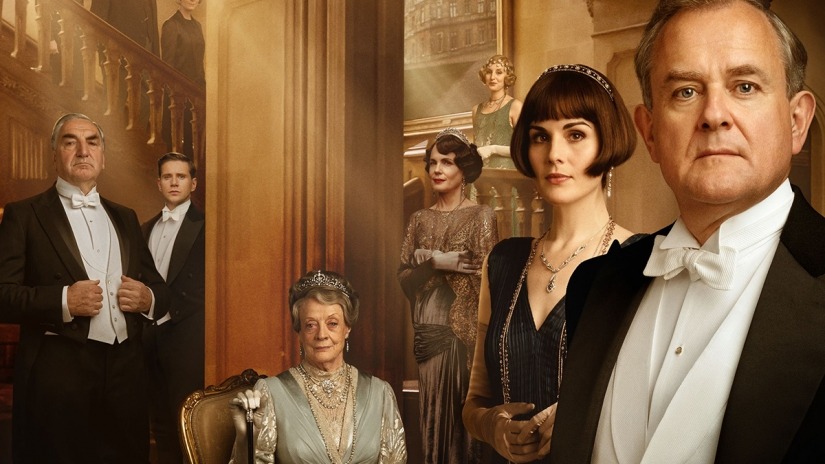
Review: Downton Abbey

Downton Abbey is the kind of film that's usually described as "a chance to catch up with your favourite characters". One problem: I've never watched the television show this movie is based on. Turns out, that was actually a plus: being aimed entirely at fans, this film had zero interest in explaining who anyone was or what their relationships were to everyone else, which made it - on one level at least - a lot more realistic to watch. These were people in the middle of living their lives, not characters that required clumsy exposition to manouver them into a place where the story could begin.

Also; not a lot of story here. The year is 1927, which realistically is about as late as it could be and still be a fairy tale setting; the Great Depression is still a year or two away, the grim 30s come after that and then there's a war and a Labour government who'll establish death duties directly designed to financially cripple these toffs. But for now, the good times are still rolling along, and who's that on the horizon? Why, it's King George and company, announcing they'll be stopping off for the night as part of a regional tour designed to forestall revolution... uh, I mean, visit their subjects.

As much of this extremely lightweight but reasonably entertaining film exists merely to let you know that various characters are still alive, the numerous subplots are extremely basic: one of the well-off sisters is worried about running the estate but eventually decides to muddle on; one of the servants is doubtful about her engagement but then reaffirms her love once she realises her husband-to-be is a mindlessly violent thug who wants to smash things when he doesn't get his way (THIS IS NOT A JOKE). As long as everything looks fabulous, who cares? And things definitely do look fab: the dresses alone pretty much justify the existence of this film, and there are also some old cars puttering about. Sadly no biplanes, which does feel like an oversight.

Not knowing anyone meant that I had no idea who I was meant to care about, but eventually I latched onto Tom Branson (Allen Leech), a Irish car salesman who I worked out was once married to someone once well-off but now dead and who seemed remarkably fine with having their child brought up by the toffs away from him (the kids get maybe one and a half moments in the film, and even then they're observed from a distance being tended to by nannies; their parents are really going to feel bad when the kids grow up as complete strangers and then die fighting Hitler).

Anyway, Tom was great, being loved by both Royals and people wanting to kill Royals, wandering around dispensing advice that basically boiled down to "it's best to just put up with shit". Which I guess is fair enough when you've already married one wealthy stunner and look likely to end up hooking up with another, but it still seems a bit crap as advice to give to someone trapped in a loveless marriage or wanting to smash the British Empire, which after all did invent the concentration camp and were the first people to use poison gas on civilians. Still, the king can ride a horse, which is pretty impressive at his age.

The closest this gets to being about anything is when a gay character stumbles into a roaring 20s gay bar - well, gay barn - which is then promptly raided by the police, who are surprisingly non-violent but presumably this being the UK they're well aware of the possibility of snagging a royal or two by mistake. Even this is relatively quickly sorted out and the whole thing ends on a "maybe they'll accept us one day" note, which is nice enough but seems a bit odd for a movie that otherwise is entirely about the naked desire to thwart all forms of social progress so well-off toffs can continue to hold fancy balls indefinitely.

Also, Maggie Smith never tells a servant to "get fucked", which was a personal dissapointment.

- Anthony Morris

Thursday, 5 September 2019

Review: It Chapter 2

Splitting Stephen King's novel It into two films always made just enough sense to seem a reasonable move. The book is massive, with a huge cast and a timeline that stretches at least 27 years (if you cut out all the history stuff; if you don't, we're talking a century or more). Obviously if you wanted to tell the story right, you were going to need more time than the bladders of movie-goers would allow; with the cast already going to be played both as kids and world-weary grown-ups, splitting the timeline up into two movies, well... made just enough sense to seem a reasonable move.

Unfortunately for anyone hoping King's big statement on horror would turn into a movie with the same kind of impact and resonance, much of what makes King's novel work is the way that it is in large part about the horror of a): being a kid and b): being a grown-up dragged back into the world of being a kid. For this to work, you really need the two playing out side by side; you split them up, and you just have a bunch of grown-ups being startled by all kinds of silly shit.

Also, much of the tension in the novel comes from the kids and grown-ups story lines playing out side by side; as you read the novel you know the kids somehow managed to fend off Pennywise the Clown (Bill Skarsgard), but you have no idea how - and part of the horror of the small town of Derry is that once you grow up (and especially when you leave), you forget what you faced as a child. Is the price required to defeat Pennywise something that as adults they'll find too costly to bear? Is it possible that they've lost the childish belief that enabled them to win and now they're all doomed? Let's find out!

Oh wait, we saw all that already in the first movie. Which goes a long way towards making this one of the least scary horror films in recent memory. Not from lack of trying, mind you: when the now grown-up Losers from the first film are summoned back to Derry by Librarian Mike Hanlon (Isaiah Mustafa), the only one who’s stayed in town, much of their time is spent split up and facing their own fears in an attempt to figure out what they’ve lost.

Unfortunately, much of what they’ve lost in the transition from page to screen is their characters. Bill Denbrough (James McAvoy) is a best-selling horror writer whose sole defining feature is that he’s bad at endings; Beverly Marsh (Jessica Chastain) escaped her abusive dad for an abusive husband who she simply leaves and never mentions again (the idea that the grown-up Losers are just repeating their childhoods would have more impact if we ever got any real sense of what their actual adult lives are like).

Richie Tozier (Bill Hader) is a snarky abuse comedian – much of the praise for Hader’s performance (which is legitimately good) comes from the fact that he’s literally the only adult Loser with a distinct personality – while the sweet but chunky Ben Hanscom (Jay Ryan) is now a studly architect, jittery hypochondriac Eddie Kaspbrak (James Ransone) is a jittery risk assessor and thoughtful Stan Uris (Andy Bean) probably shouldn’t have thought quite so much about what returning to Derry would be like.

In the novel, a lot of the horror in the adult sections comes from the way Pennywise - who can't directly kill adults, although maybe he can - manipulates the mundane horrors of the adult world to serve him. Here that's reduced to a brief and forgettable subplot involving the return of one of their childhood bullies, mullet still intact. 

Then again, pretty much everything here is reduced to a brief subplot (the novel's most powerful idea, that Pennywise's centuries of evil have soaked into Derry and turned the whole town rotten, is all but ignored); every character has to get at least two scary encounters with Pennywise, and once you've got to fit in twelve jump-scare packed scenes and a big climax there just isn't much room left for anything else even when you're pushing three hours.

That said, while it may not hang together well as a film It Chapter 2 does definitely have some memorable moments; the film's most frightening scenes don't involve the Losers at all. And Pennywise does get to pull off a few bizarrely surreal antics to remind audiences that he's meant to be an almost Lovecraftian avatar of unknowable evil, not some cannibal bozo. 

But the split in structure does irreparable damage to the story, and the numerous flashback scenes featuring the younger cast don't help (none of them are scary for starters, which constantly defuses what little tension the film builds up). Stephen King's novel is notorious for being an overstuffed mess; somehow, this film manages to outdo him.

- Anthony Morris


--> -->