Search This Blog

Thursday, 24 March 2011

Missing the Point Entirely: Never Let Me Go


The obvious thing to say about the science in the science-fiction film Never Let Me Go is this: it’s a metaphor. In fact, it is so obviously a metaphor that to try to engage with the science any further is a clear waste of time. And yet, and yet....

Yes, the (slight) science-fiction angle is used to sharpen the tale of young people for whom death comes too soon, who cling to relationships not out of love but of fear of being alone, who try to make things right in their lives only to discover that it’s too late, they’ve run out of time and the future they though they could reach thanks to the goodness in their hearts – well, society has in mind an entirely different use for their hearts. But that doesn’t mean the science doesn’t have to make some kind of sense.

The story itself is about Cathy (Carey Mulligan once she grows up) attending a strange and closed-off English boarding school in (a parallel world version of) the 1970s. Turns out it’s closed-off for a reason; advances in science reaching back as far as 1952 (so presumably it was a spin-off from Nazi science, and we all know how that operated) means that the average life-span of a human being in now over 100 years. But to live that long, they need regular “donations” – organs taken from clones, who rarely survive past the third or fourth ‘donation”. Cathy and her friends are clones, and an early death is all they have to look forward to.

Most of the film is taken up with their relationships (Cathy falls for a boy who is snatched away by her best friend; it’s not until the pair are broken by their donations while Cathy is a temporarily exempt ‘carer’ that she gets a second chance) and with exploring the unsettling but believable passivity with which they accept their fate.

Again, taken purely as a metaphor to heighten the poignancy of their plight (they don’t have long to live before they’re killed by a society that sees them as less than human), the science does its job. But this isn’t a fantasy film: it goes out of its way to create a realistic version of the rural England of the 70s and 80s, without a hovercar or lazer gun in sight.

So with that in mind, how does this life-saving medical breakthrough work? The clones aren’t clones of the people they’re donating to – the film makes clear that they’re “modelled” on the dregs of society, who’re hardly the ones at the head of the queue for life-saving medical procedures. So it’s not some kind of organ donation scheme as we know it - and how would trading individual organs prolong life in every single possible case, especially when they’re organs the donors seem to be able to do without?

More importantly, where are all the other clones? Even if each donor gives up four organs, and one new organ is all one regular person needs, you still need millions upon millions of donors. The school Cathy attends is identified as being special, the equivalent of a free-range farm, but still: you’d expect to see an awful lot of giant concrete towers in the background of the shots to store all the “battery” clones.

Okay, perhaps the organs are taken out and turned into a magic life-giving paste so you don’t really need that many clones. But if they don’t need that many clones, that’d make them kinda rare. Wouldn’t you keep them under lock and key? And the donors are able to wander around the countryside, doing pretty much what they want (though we are told later generations are kept like battery hens) – after such an investment, wouldn’t those responsible want to safeguard their investment? What if they get sick?

All of this is clearly not what the film wants you to pay attention to. But it’s a little like a magic trick: once you know how it’s done, you can’t go back to only seeing what you're supposed to. Knowing that the world in the background of this (generally effective) story doesn’t really work means the story itself loses a lot of its power. The locations become cheap sets, the emotions merely scripted words, and the heart-wrenching drama of people trapped in lives that end too soon… well, they were never really alive in the first place, were they?

Anthony Morris

Thursday, 3 March 2011

Stop Using Sex As a Weapon: Hall Pass


The concept behind Hall Pass is simple: a couple of guys are given a break from their marriages by their wives so they can cat around. Much like the other recent Hollywood relationship comedy No Strings Attached, it dangles the promise of fun outside the oh-so-narrow confines of a traditional relationship, only to yank it away: of course the guys are going to learn that being single is in fact a horrible nightmare and they’re going to rush back into the arms of their smug wives. Why are we watching this film again?

Just because we know how a journey’s going to end doesn’t men the trip's not worth taking though, but here what seems like it should be a wild and hilarious romp (well, hilarious by mainstream Hollywood sex comedy standards) largely turns out to be a dull, painful, trudging grind. Much of the blame needs to be laid at the feet of directors the Farrelly brothers, whose one classic film (There’s Something About Mary) is still getting them work despite their repeated inability to imbue their subsequent films with anything approaching that film’s charm, nuance, or comedy. Their films are, on a basic level, crude - they're filled with ugly characters and blunt situations, and they really need a nuance-free comedic set-up if they're going to work at all.

Mary worked because it had such a set-up: Mary was the girl of every man’s dreams, and so a whole bunch of weirdos and freaks fought over her. Hall Pass, on the other hand, is about that point in a marriage where things get stale and the good old days loom large. Who are we supposed to cheer for here: the guys who want to leave their wives and sleep around? The wives who let them, then get tempted themselves? How do we want this story to play out anyway? Their marriages have to be pretty flat for the guys to want to have a break, even for a short while – are we really going to cheer when they rush back in?

The film attempts to dodge this bullet the traditional way: one couple is the “real” couple, while the other is the “comedy” couple. As always, the comedy couple feels more real because they’re allowed to be pissed off and unhappy; the real couple is basically so happy it’s a bit of a puzzle why they’re getting into all this anyway.

This doesn’t really hide the fact that the guys are pretty much sleazebags, mind you; all they do up until they get the hall pass is perv on other women and make sexist comments. In a simpler film, this’d be a simple case of “be careful what you wish for”. These unlikable guys would be set free, discover being single is a nightmare, and at the end of the week run back to their wives swearing never to stray again.

[sadly, this is the state of play in Hollywood rom-coms. A film that seriously suggested that a bad marriage was one you should leave, or that some relationships aren’t worth saving, would be more than a little controversial. Even The Dilemma, which did feature a break-up, made sure to also present a successful relationship – two, if you count the bromance.]

Instead, this feels an obligation to have it both ways: the guys are actually offered hassle-free sex after less than a week on the market. You’d have to think with that kind of strike rate the temptation to stray next time the marriage is going through a dry spell would actually increase. Seriously, these guys have been on the market less than a week – more than half that time being taken up with over-eating, getting stoned, having penises waved in their faces at the gym and so on – and they still score? So this film is saying being single is good now? Well, sort of: plenty of bad things happen to them too, so the moral is… um… if you don’t want to have anything interesting happening in your life, stay married?

Of course, the real problem here is that this film is trying to be all things to all viewers. This concept would work as a film for men: two guys escape their battleaxe wives for a week, then return home having let off some steam. It’d work for women: two wives let their oafish partners off the leash, then laugh as they come crawling back. What it can’t do, no matter how hard the Farrelly’s try, is work for both audiences. The story’s being pulled in two directions; like listening to a guy trying to tell a joke he can’t get straight, eventually you stop caring.

Anthony Morris

Sunday, 30 January 2011

Dead End: Death Sentence (DVD)


Vigilante movies are as formulaic as movies get. That’s what gives them their power: they’re more like rituals than narratives. The audience is dragged through a series of emotional checkpoints and the film succeeds or fails not through innovation, but on how well it delivers what we’ve come to see.

The rules were laid down by 1974’s Death Wish: an average citizen has a family member or members bashed, mugged or killed by criminals. They swear half-thought-out revenge and start killing, tentatively at first then with increasing skill. The police – who were useless when it came time to prosecute the original criminals – soon get on the case, and the criminals start to fight back too.

Most of the variations on this formula, especially in recent years, have been minor ones. In The Brave One, the vigilante is female (Jodie Foster); in Harry Brown the vigilante is an old age pensioner (Michael Caine); in Paparazzi, the vigilante is a movie star hunting down life-threatening celebrity photographers (it’s actually better than it sounds).

So with the rules so firmly in place, why does Australian director James Wan (the original Saw) make Death Sentence – which in every other respect ticks the boxes as efficiently as any of the previous films - spend well over half its running time dwelling on what is the most obvious and least interesting part of the story: the hero’s decision to fight back? The entire point of the vigilante movie is to give the audience the satisfaction that comes from seeing scum get theirs: seeing the hero stand around for over an hour going “gee, I don’t know…” is missing the point by a wide margin.

Things start off in the traditional fashion, with roughly ten (seemingly endless) minutes of Nick Hume (Kevin Bacon) having fun with his loving, perfect family before he and his eldest son first encounter the gang of street scum; suffice to say, things don’t go well for the son.

When the resulting case goes to court, Hume’s faced with the grim facts of the justice system in vigilante movies: the man who killed his son (senselessly – despite looking like a robbery, it was in fact a gang initiation, bringing the vital element of senselessness into his death) is going to get off easy even if Hume’s testimony puts him away. What does Hume do? He says the killer didn’t do it so he’ll be put back on the streets where Hume can take care of him himself.

While this makes almost zero real-world sense (Hume is a pencil-pusher who within the space of five minutes decides to tackle a member of a violent gang on his own?), it’s perfectly logical within the vigilante movie genre – how else are we going to see some scum cleaned up off the streets?

Hume tracks down his son’s killer to his apartment block, confronts him, and after a clumsy scuffle where the killer pulls a knife, accidentally kills him. In a traditional vigilante film –Harry Brown, The Brave One, Paparazzi, all the way back to Death Wish – our hero gets the hang of killing quickly, and the film moves onto questions of who they’re going to kill and will the police catch up with them.

In Death Sentence though, Hume now becomes the hunted, as the gang decide to take revenge on their friend’s killer. They track Hume down, confront him, shoot wildly at him while he flees into a parking garage where he (again, accidentally) manages to kill a couple more of them. Throughout he’s on the back foot. He’s unleashed something he can’t control, is constantly looking for a way to make it all stop, and, as the police repeatedly and unhelpfully tell him, what comes next is his own fault.

In a better or more original film highlighting Hume’s fear as his scheme backfires might work. But in every other respect – thin characterisation of the family, generic street scum lacking all redeeming features, a laughably offhand view of the courts, action movie-style violence - Death Sentence is nothing more (or less) than a traditional vigilante movie. While Hume’s fear in the face of the gang’s retaliation is “realistic”, vigilante films work on an emotional level rather than a realistic one, as shown by his snap decision to deal with his son’s killer himself. Dragging out this stage of the story doesn’t feel like a natural outcome of the plot, or a post-modern attempt to tweak the genre; it’s just dull.

What comes next is (finally) what we came here to see: the gang break into his home and shoot everyone at point-blank range. Still, as seen in the earlier confrontation, they really are The Gang That Couldn’t Shoot Straight: Hume lives, as does his younger son (in a coma), leaving his wife the only one dead. Hume, finally realising what has to be done (and what kind of film he’s in), breaks out of hospital, buys a sackful of guns (ironically enough, from the crime gang’s Kingpin-style overlord [and father of its leader], played by John Goodman), and tracks down the bad guys to their lair in a disused mental hospital (of course).

It’s the traditional guns-a-blazin’ ending to a vigilante story, in the same way that the opening ‘happy family” scenes made for a traditional opening. So why waste so much time wavering on the question of “does violence solve anything” when we all know that here it not only solves everything, but is the sole reason for watching the film?

At first it seemed like the answer might lie in the source material. According to the credits, Death Sentence is based on “a novel by Brian Garfield” (it’s important to be specific, for reasons that will become clear). Garfield wrote Death Sentence back in the 70s as a sequel to his novel Death Wish, which the film was based on. Garfield has said publicly that the film – which had been a huge commercial hit, had a massive cultural impact in the US and went on to spawn four sequels – had glorified the idea of vigilante justice against his original intentions. He had intended Death Wish to be a cautionary tale: when everyone believes in “an eye for an eye”, eventually everyone ends up blind.

Cast in that light – and knowing that in a parallel world Hume was Kersey – the wavering that makes up two thirds of this film almost makes sense: a man who’s put his violent past behind him is forced to wonder whether the cycle of violence can ever really be broken. If Charles Bronson was able to reprise his most famous role, this could have been his version of Unforgiven, Clint Eastwood’s reflection on his western roles. After all, both revolve around a former killer dragged out of retirement to confront and re-assess his / the actor’s past.

[That said, Unforgiven has the advantage of an interesting setting, well thought-out supporting characters and a considered stance on violence; even if Bronson had somehow starred in Death Sentence as a direct reflection on his most iconic role, this film still has a one-dimensional supporting cast, generic settings, and pretty much nothing to say about violence past “shotguns are cool”.]

If this wider context had been available to Death Sentence, its drawn-out middle section would have had at least some point as far as raising questions about the usefulness of vigilante justice (before answering them the same way all vigilante films do: in a hail of gunfire cheered on by the audience). But in the film Hume has no violent past to reflect on, no history as a killer to add depth and context to his actions and concerns.

[And then, after I’d already written most of this review, I actually found a copy of Garfield’s Death Sentence novel in a secondhand store. If the movie’s based on a Garfield novel, it sure ain’t this one: the lead has no family and does not get in an eye-for-an-eye tussle with a street gang, but does have to deal with a rival vigilante, political grandstanding, social ramifications and… basically Death Wish 3 is a more faithful adaptation of Death Sentence than Wan’s film. They've taken the name and made up their own story to fit.]

So there's not even the lingering trace of a deeper meaning left over from the source material. This just simply takes forever to get to the point. Even if it seriously intended to say that vigilante violence was bad, Wan clearly loves violence (and in the unrated edition, gore) so much he can’t help himself. There’s no serious attempt here to tackle the idea that killing is bad rather than bad-ass: when all the violence is thrillingly shot with loads of bodies flying and blood spraying, the bland stretches where Hume refuses to man up and kill do nothing more than make him an annoying pain refusing to give us what we’ve come to see.

The result is notable solely as a failed experiment. There may very well be ways to tweak the vigilante formula to make it more crowd-pleasing or efficient; even Death Wish didn’t get it right first time (Kersey never kills the scum who killed his wife and raped his daughter; in pretty much every vigilante film since, the hero is solely out for personal revenge - though in my mind that makes them less interesting by far).

There may even be ways to make a vigilante film that seriously questions the nature of violence (presumably the “vigilante” would then have to be revealed for who he really is: a serial killer). But as a genre piece and as a piece of art, Death Sentence is nothing more than a dead end.


Anthony Morris

Thursday, 27 January 2011

Us vs. Them: Another Year


Mike Leigh’s latest film is full of warmth and humanity – so long as you’re on the right side of the line. There’s no serious arguing that the line isn’t there in this modern-day London of haves and have-nots: on one side are our nominal leads, content 60-somethings Tom (Jim Broadbent) and Gerri (Ruth Sheen), their son Joe (Oliver Maltman) and his bubbly partner Katie (Karina Fernandez), and contented mother Tanya (Michele Austin).

What puts them ahead of the pack isn’t so much their wealth – though they all seem to be doing ok – but their emotional well-being. They’re all happy with their lot, leading lives full of love and companionship. Meanwhile, sharing the same physical space but off in a world of hurt, are the have-nots: Mary (Lesley Manville), the somewhat scattered co-worker of Gerri and Tanya, and Ken (Peter Wright), Tom’s childhood friend. They’re crushingly sad, constantly alone, and more often than not hitting the booze a little too hard.

Set over the course of a year, the film basically charts Tom & Gerri’s social life as Mary outstays her welcome, Ken drops in for a visit, Joe finds a partner and eventually Tom’s brother Ronnie (David Bradley) appears on the scene after the sudden death of his wife. There’s no massive dramas here or large-scale character shifts, which makes its subtle distinctions all the more devastating: some people just live lives of warmth and happiness, and some don’t.

But why? What causes this sharp divide? A clue lies in the two characters that undergo serious change in their situation across the length of the film: Joe finds a girlfriend and Ronnie loses a wife (though we don’t actually see him while his wife was alive). It could be argued that these changes make no difference to their well-being: Joe seems pretty happy when we first meet him as a single man, and while we have no idea what Ronnie was like when his wife was alive, his non-existent relationship with his angry – and presumably single - son Carl (Martin Savage) suggests he wasn’t an ideal father.

If that’s the case though and having a partner makes no difference to Joes well-being, why does he find someone at all? Well, he’s clearly been looking for a girlfriend (not every single person is), and there’s no suggestion that she makes his life worse – according to Gerri & Tom, his having a partner is a distinct improvement over his being single. As for Ronnie, he’s not exactly jumping for joy over the death of his wife: suddenly becoming single is clearly not a step forward for him.

Joe’s finding a partner does fulfil another plot function: it separates him from Mary. When he’s single, she’s constantly making moves on him – moves he rebuffs, if gently. When his partner arrives on the scene, Mary sulks, and her hostility poisons her relationship with Tom & Gerri too.

You could also argue that Ken’s character’s role in the plot is also Mary-centric: he’s single, he hits on her, and she knocks him back. As the film develops the focus is increasingly on her: if everyone else is there simply to illustrate aspects of her character, then the only real divide here is between her and everyone else.

Unfortunately for that argument, while Mary is increasingly the film’s focus, there are enough scenes around Tom & Gerri (and without Mary) to make clear that this is a film about a group of people. And as a group, there are clear haves and have-nots. After all, if Ken is there simply to show that Mary rejects companionship, why make him so pathetic? Is a fellow lonely drunk the best she can expect? If so, that only re-enforces the divide: Gerri gets the warm-hearted Tom, Mary gets a drunk a brisk walk away from a heart attack.

As for Joe, his move into coupledom certainly distances him from Mary, but that also only re-enforces the divide: he escapes Mary and her sad drunken world not by getting a better job or an exciting new hobby, but by finding a partner. It’s made plain and clear - all the single people in this film are sad, all the people with partners are happy. Dark pasts and failed relationships might be hinted at to explain Mary and Ken's current state, but they're only hints: as far as what we're shown on the screen goes, they're single, therefore they're unhappy. And being single is their own fault. After all, Joe found a girl, and look how well that worked out.

That said, this is largely a film about older people: could it be that it’s their attitude to aging that’s depressing them? After all, Ken and Mary are still out and about trying to keep up with the kids; Tom & Gerri have settled down into a comfy later life, pottering around down the allotment and so on. Maybe accepting your age is the key to happiness here?

Trouble there is, both Ken and Mary are single, and trying to find a partner is a young person’s game. The film might archly suggest that they’re a bit past it as far as hanging around pubs goes, but how else are they supposed to find someone? They’re merely the last ones left at the life-long session of relationship musical chairs, going through the same motions to try and find someone long after everyone else has paired up and gone home.

All this wouldn’t be so bad if the film itself didn’t clearly take sides. Mary and Ken are seen as mildly annoying impositions on (and by) Tom & Gerri (in contrast, they love Joes’ new partner), while Mary and Ken seek out Tom & Gerri for friendship. It’s a world where single people hit the bottle and annoy their partnered friends, who tolerate their presence at best – usually while rolling their eyes the second they’re gone as they snuggle up together in a big cosy bed. Mary, on the other hand, gets a shit car.

Clearly, the clock is ticking: if you’re single and you don’t find someone, you’ll be left on the shelf. The consequences of which are spelt out plain for all to see across Another Year’s two hours: single people are ditzy, often drunk, pathetic and painfully needy, worthy of little more than subtle contempt and dismay from their paired-off “friends”.

If this wasn’t harsh enough, Another Year opens with Tanya (who’s a doctor) trying to help a clearly closed-off and clinically depressed woman (Imelda Staunton). She’s never seen again after the opening scene, but her pinched-off answers to Tanya’s questions suggest a world where people lock themselves into personal prisons and refuse all help to escape. You’re sad because you’re single, and being single is all your fault.

Anthony Morris

Thursday, 20 January 2011

In The Company of Chumps: The Dilemma


Over the last few years Vince Vaughn’s charted a course slightly askew from, well, pretty much everyone else in the romantic comedy business. Everyone else almost always focuses in on the beginning of relationships; he makes films that are a little more interested in what happens after the fun stops. Not that anyone’s going to confuse The Break-Up or Couples Retreat with Carnal Knowledge in a hurry, but compared to yet another tortureporn effort where some poor chump settles down with / has his nuts cut off by Katherine Heigl, at least he actually seems to be attracted to projects that spend at least a couple of seconds thinking about exactly what “happily ever after” actually entails.

So knowing that Vaughn tends to like making rom-coms that make you at least momentarily question the nature of romance (and more often the nature of comedy, considering their often more miss than hit approach to gags), the opening scene of The Dilemma brings with it zero surprises, Basically, the cast - Vince, Kevin James (clearly taking on the Jon Favreau [Vaughn's long-time cohort and co-star in Swingers, Made and more recently Couples Retreat] role), Winona Ryder as James' wife and Jennifer Connelly as Vaughn's girlfriend – sit around talking about honesty and its importance in a relationship. If you're even slightly familiar with the works of playwrights like Neil LaBute (and why hasn’t Vaughn teamed up with LaBute yet? Someone start that Facebook page), you'll recognise the gambit: everyone stakes out their views on honesty, and then circumstances contrive to make them either give up their principles and become hollow shells or stick by them and ruin their lives.

Problem here is, we then get ten minutes or so of crap "bromance" hijinks as it's established that Vaughn and James live in each others pockets (they have their own company together trying to make electric cars sound like muscle cars - but more on that later) and that Vaughn is a rapid-fire blabbermouth who thinks the best way to sell his rumbling engines to auto executives is by calling regular electric cars "gay". The "gay" line's an odd one, because we don't know how to respond: is it supposed to be funny (it's not, unless you're one Melbourne critic who all but pissed his already stained pants at it), or is it supposed to be as awkward for the characters on screen as it is in the cinema?

Either way would work for the film - Vaughn is playing a bit of a dickhead who lets his mouth run away with him so there's the drama covered, and the wacky work pitch is a comedy bit that often gets laughs - but because this film is staggering all over the place like a dog who's spent the day sucking up spilt beer we don't know. Last time I checked, being confused doesn't usually mean you're having a good time.

Anyway, the movie stumbles on with no real idea of what its trying to do - the guys' company is struggling and that's meant to be serious, but Queen Latifa is playing an inappropriately explicit auto executive saying stuff like "I want to have sex with your words" which is presumably funny but who can really tell - and then finally things click into gear when Vaughn, while planning out his marriage proposal in some giant greenhouse full of exotic plants, sees Ryder making out with some other guy. Serious moment, right? Not once Vaughn has finished crawling through poison plants to spy on them! Hah! Wait, no hah.

You can almost see what they're trying for here, and in a sillier film it would probably work. But this is a film that doesn't trust you enough to figure out that there's anything at stake here. In a regular comedy, film-makers just assume the audience knows that discovering that your best friend's wife is cheating on him is serious and sad, and then move onto being funny. But after this scene - which, like I said, almost works because he's actually seeing something serious while doing something stupid - the film just keeps on going on and on about how this is a really serious and sad situation before cracking a couple of lame jokes. It's like the film is a crap stand-up comedian prefacing every single one of his one-liners with "sorry your wife's a cheating skank": it kinda kills the mood.

Then it gets even stranger. "Serious grown-up issues" and "laugh-out-loud comedy" rarely go hand-in hand, but when Vaughn corners Ryder and confronts her about what he saw this goes out of its way to be grown-up about the whole thing. Turns out that James has been cold and distant to her no matter how hard she tries - so distant, in fact, that not only has he stopped shagging her, he's off down the Asian massage parlour every Thursday for a hand shandy. And this grim, tragic look inside a dying marriage is funny how?

Ryder does get to put this scene on her showreel though, as she suddenly turns into Satan's Daughter by turning on the fake waterworks to show how she'll lie her way out of it if Vaughn tells James about what happened. So she's the bad guy, right? We can cheer when she gets her eventual comeuppance - and more importantly, laugh as she ends up going through the wringer? Nope: she goes back to being a heart-wrenching figure of pity (or just someone who looks sad and seems trapped) in every single other scene she's in. So no laughs there.

And there's not a whole lot of laughs (let alone laffs) to be found when Vaughn follows James to the massage parlour and discovers that yes, his best mate has gone there to be wanked off by a massage parlour boss who basically comes out into the front of the place and says "we're going to give you an excellent hand-job tonight!". Geez, hope there are no law enforcement agents in a three block radius to overhear that.

Usually hand-job material is comedy gold, but don't forget: he's getting one while he's still married and his heart-broken wife knows about it. Urgh. Even those sitcoms where married couples just insult each other non-stop never went that far. So Vaughn is confiding in his girlfriend about all this shit, right? After all, in like the second scene of the film Ryder says to him something like "We really like her and she's not even one of my friends!" so you know there's no girl bond between Ryder and Connelly. Of course he's not: he lies to her like a maniac for no reason so she can start thinking he's gambling again. Hilarious!

Then we get a bunch of scenes where James acts like a dick - surprisingly well too, and to be fair the acting in this film is pretty sharp from top to bottom - just to make sure we know his crumbling relationship is his fault as well. Then Vaughn actually prays for guidance - again, begging God for help without a trace of irony is not exactly comedy gold - then suddenly he's pulling some stalker shit outside the house of the guy Ryder's f**king and guess what? He's a tattooed-idiot called Zip, so there goes the sympathy for her the film was trying so hard to create a few scenes back.

At this stage you might be thinking "is this even supposed to be a comedy?". Problem with writing this off as just a clumsy drama is that Zip (Channing Tatum) is actually on-purpose funny, which means he seems to have come from a completely different movie (one that mostly involves beating the crap out of Vaughn). One half-baked comedy intervention for Vaughn's gambling later and the secret's out, Ryder tearfully vanishes from the film forever and the true point is revealed: can James and Vaughn's friendship survive? Hang on, what?

This might have been a dilemma - geddit? - if James' cheating wife had been an evil skank. But hasn't half this film been telling us that their marriage was hurtling down shit creek sans paddle for both of them? If James is so massive a tool that he'd get pissed off at his friend for telling him his wife was sleeping around at the same time as he's got a regular booking down at the Five Fingers of Hope Saloon, why the f**k should we want Vaughn to stay friends with him?

The result is that there's just no drama there at all: the film was so desperate to avoid making Ryder the villain that there's no dramatic tension at all in whether the friendship survives. James has been an obvious shitbird, Vaughn hasn't been a whole lot better and they deserve each other so just end the damn film already. Only not with a bizarre scene where James knocks a hockey puck through a tiny target to win a prize and a giant hug from Vaughn because a guy firing a projectile through a tiny opening seems a little bit much like a sex thing.

One massive question remains (okay, two, the first being how the hell did two slobs like Vaughn and James land amazingly hot dames like Connelly and Ryder when they're clearly not even that interested in them): considering this is a movie that makes such a massive deal about the question of honesty - and, surprising no-one, comes down hard on the line that honesty is the policy to take out - why does it also make such a big deal about James and Vaughn's day job considering said day job is entirely based around making a car engine sound like something it's not. It's a, you know, deception? A big fat, bass-heavy rumbling lie?

That's right: in a film about being honest, their job is basically about lying to people. Is it a metaphor? A hint that while the characters conclude one thing about the importance of honestly, the film is saying something else? With something as all-over-the-shop as The Dilemma, who the f**k knows?

Anthony Morris

Friday, 7 January 2011

Best of the Year: 2010


Standout Film

Toy Story 3


It’s hard to believe 15 years have passed since the first installment of Toy Story, the stunning Pixar animated film that delighted both adults and children. Sequels are notorious for being calculated rip-offs, but the beauty of Toy Story 3 is that this ‘threequel’ treats the now familiar characters with integrity, while advancing their story-lines in ways that entertain, surprise – and let’s be honest – scare the living daylights out of – the audience.

No other film this year has had me sobbing so uncontrollably. There’s a scene where the toys hold hands as they cling to a conveyor belt that’s hurtling towards an incinerator. Surely this is one of recent cinema’s most poignant depictions of the consolations of friendship as we confront our inevitable mortality. Reading too much into it? No. The Toy Story films have always been brave enough to tackle dark themes of abandonment – after all, the toys get left behind as their owners grow into adulthood. It’s tragic. Luckily, there are lots of laughs, inventive set-pieces (like the meeting between Ken and Barbie) and thrilling action sequences to leaven the bitter-sweet loaf. One of the most successful films at the 2010 box office, this proves it’s possible to please crowds with style, and dare I say it, profundity.

Other film highlights:

The Ghost Writer: Roman Polanksi’s beautifully paced and elegantly directed thriller about a ghost writer (Ewan McGregor) hired to write the memoirs of an ex Prime Minister (Pierce Brosnan) accused of war crimes, this is melancholy and sly.

Fish Tank: Powerful performances and a bleak urban beauty infuse a tough tale set in a British housing estate. Directed by Andrea Arnold (Red Road) Fish Tank portrays an angry and isolated 15-year-old girl (Katie Jarvis) who falls for her mum’s boyfriend (Michael Fassbender).

A Single Man: The directorial debut of fashion designer Tom Ford, this sublimely beautiful and moving film stars Colin Firth as a 1950s college professor the mourning the death of his lover (Matthew Goode). Set over the course of a day, it’s a lush meditation on life, love and lust.

The White Ribbon: Michael Haneke’s black and white masterpiece comments obliquely on the rise of Nazism with its tale of mysterious violent crimes occurring in a farming village at the onset of World War I.

Leap Year: Australian director Michael Rowe won the 2010 Cannes Camera d’Or for this confronting and sexually explicit Mexican film about a solitary young woman dealing with grief and loneliness.

I Am Love: Tilda Swinton is the respectable matriarch of a rich Milan family, until she falls desperately in love with her son’s best friend. A sumptuous and sensuous melodrama that pits passion against bourgeois convention.


The Kids are All Right
: Julianne Moore and Annette Bening shine as a bickering lesbian couple whose family is rocked when their teenage children decide to meet their biological dad (Mark Ruffalo). Funny and affecting, it’s a comedy for anyone in a long-term relationship.


South Solitary
: An Australian film that divided critics, South Solitary comes from the highly original writer/director Shirley Barrett (Love Serenade). The film features Miranda Otto in an adorable performance as a not-so-young woman who’s run out of options in 1920s society and finds herself living with her uncle (Barry Otto) in a remote lighthouse. Marton Csokas and Essie Davis also feature in a strange, halting and salty romance that’s very funny in its own quiet way.

Exit Through the Gift Shop: Real or hoax? It doesn’t really matter in this hilarious documentary about notorious graffiti artist ‘Banksy’ and the man who obsessively follows him with a video camera. A smart guerrilla expose of the pretentions and paradoxes of the art world.

Looking forward to 2011

Another documentary causing speculation about its authenticity is Catfish (27 Jan), a story of three friends who document a budding Facebook romance only to find that the woman involved may not be who she says she is. From the personal to the political, a documentary that’s set to terrify us all is Countdown to Zero (26 Jan) tracing the history of the atomic bomb and the current dangers we face in the case of accident, terrorism or failed diplomacy.

Fans of French auteur Claire Denis (Beau Travail) will be keen to catch her latest film White Material (limited release from Jan), which stars Isabelle Huppert as a plantation owner trying to keep her family together in a warring African country. Also in January, the Coen Bros’ latest offering, True Grit will hit screens on the 20th. Set in the Old West it stars Jeff Bridges and Matt Damon as two lawmen tracking down a murderer.

Other big name directors bringing out new titles include Mike Leigh, with comic drama Another Year (26 Jan); Clint Eastwood, with supernatural thriller Hereafter (Feb 10); Danny Boyle, with the true story of rock-climbing survival starring James Franco, 127 Hours (10 Feb); and Peter Weir’s much awaited escape drama The Way Back (24 Feb), a story based on fact about soldiers who break out of a Siberian gulag in 1940 and walk 4000 miles to freedom.

Here's to a new year at the cinema - and lots of resolutions to blog more often!

Rochelle Siemienowicz
(A version of this post originally appeared in edition #370 of The Big Issue magazine.)

Monday, 20 December 2010

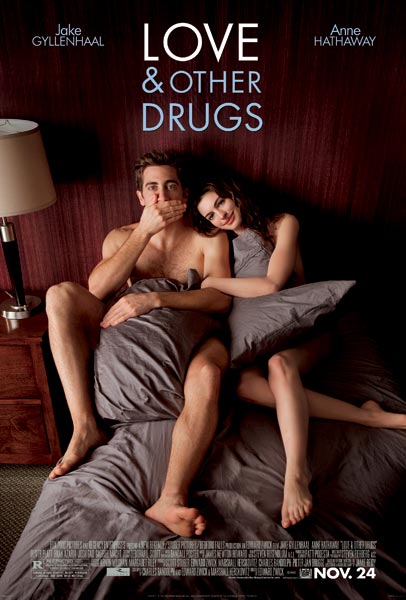
So much for the afterglow: Love and Other Drugs


There is one scene in Love and Other Drugs that sets up why this film looked so promising. Unfortunately, this scene isn’t currently commercially available as a stand-alone segment, which is a shame as every other moment in this film is good for little more than encouraging you to drive a railway spike through your forehead. But for one moment in one scene, you can almost maybe just see into a parallel world where this movie wasn’t a total waste of time.

In this scene, our leads Jamie (Jake Gyllenhall) and Maggie (Anne Hathaway) are lounging around in a post-coital fugue, talking about… well, it doesn’t really matter: every line of dialogue in this film falls like lead shot from the lips of the cast, usually hitting the ground with a muffled thud, occasionally creating a clanger that will endure until the sun grows cold (“She’s Thai. And I’m Thai-curious”). But here they’re both rolling around on the bed with a – for Hollywood – surprising ease as far as nudity (mostly Hathaway’s) goes, creating an atmosphere that we don’t often get in western films. Two people who seem to like each other have just had sex, and now they’re soaking up the afterglow.

It only seems like a smart moment in the context of prudish western film-making, with its L-shaped sheets and one-time-only kisses. It that context, even this film’s depiction of a kind of relationship that we all know from real life but never see on film – a relationship built almost entirely (at first) on sex – seems daring. But being the world’s tallest dwarf is nothing to be proud about, and this one brief moment of relative humanity only makes the robotic dreck that surrounds it all the more painful.

Story-wise there are actually two stories going on here: one involves Jamie’s efforts to become the best-darn salesman for Pfizer he can be, but you needn’t pay too much attention to that one because the film is set in the mid- to late-1990s so along comes Viagra and even the most disinterested Sportsgirl salesgirl could sell that. It’s actually hard to remember a recent mainstream film where so much effort is devoted to such a major plot thread that ends up going nowhere: it’s not like he’s a slacker who lucks into a product that sells itself, or a loser whose career is saved by this awesome self-selling product – he’s a good salesman, being a good salesman is important to his self-image, and then this drug comes along that takes away all the skill and ability from his profession and… it just doesn’t matter. His arch-nemesis in drug sales vanishes from the film, his co-worker (Oliver Platt) gets half a scene at the end that means nothing –

[Actually, let’s explain that: Platt wants to be a success so he can get a gig back in Chicago close to his family, and he thinks Jamie’s slick ways will get him there. Platt’s character pops up every now and again to crack wise and dispense job tips, Viagra comes along and it’s money in the bank, and then we get a scene where we learn that Jamie is going to Chicago but Platt’s character isn’t. Viagra sells itself (or so we’ve been told), so why is Jamie getting a bump over his more senior colleague? No doubt there could be a dozen reasons, but the only one we’re given (sez Platt: “they need me here”) is presented as nothing more than excuse-making by a broken man. It’s a sign of how sloppy this film is: Jamie strives for success in a world where things happen for no reason, and yet we’re still expected to care about his success.]

-and otherwise, a few cheap and nasty gags about how drug salesmen work aside, this side of things adds up to nothing more than a bauble Jamie can throw away at the end to prove how much he loves Maggie. Because that one brief, mostly-naked bedroom scene aside, this is the kind of romantic comedy that runs on rails to a destination that only looks attractive from a long, long way away.

We learn three things about Maggie when we first meet her in a doctor’s surgery: she’s sassy, she has early-onset Parkinson’s Disease, and she’s got nice breasts. Surprisingly, of those three things it turns out that being sassy is the least important, as, after some slightly more spiteful than usual banter, she promptly invites Jamie home to her sweet loft for some no-strings sex, which soon becomes a regular event. The frequent sex is another thing that might fool more gullible viewers into thinking this film is smarter than it actually is: whereas most Hollywood rom-coms restrict the sex scenes to one or (if they need to have the sex interrupted comically or start to go bad) two, this keeps ‘em coming well past the usual cut-off point.

The film makes no secret of the link it’s forging between her free-wheeling sexual ways and her illness. While it’s possible to see her illness as some kind of punishment for being a young woman who likes sex, lets give this film the benefit of the doubt and say that her illness (and awareness that for her, life as an able-bodied person is short) fuels her hunger for sex. It doesn’t fuel her appetite for much else tho – she’s an artist, she works in a café (good job paying for the sweet loft on that wage, especially as she can’t afford drugs and has to go to Canada on a bus for the cheap stuff), and there’s not a single “look at me and all the things I’m trying to cram into my life” montage anywhere to be found. She just likes to fuck. A lot.

Which, when you think about it, is pretty fortunate for her. After all, why else would Jamie want to be with someone with an incurable illness unless she was constantly up for it? There’s nothing else to her character her to suggest any other reason for him to fall in love with her, after all – she’s constantly pushing him away verbally, she’s got the whole illness thing going on – if she didn’t want to sleep with him all the time, why would he bother hanging around? Don’t blame me if this sounds offensive: while it may be possible to come up with another reading of the situation here, it’s hard to ignore the way this film constantly re-enforces the sexual nature of their relationship in a way that most other Hollywood romantic comedies and dramas don’t. Considering there’s almost nothing else to her character, it’s difficult not to read this as “hey, why else would you fall in love with a Parkinson’s sufferer?”

Offensive to both men and women this undoubtedly is, but at least it fits in somewhat with the jerk Jamie seems to be. And in some early scenes together their horrible, stilted, clichéd dialogue almost makes sense: he’s a heartless jerk, she’s a victim desperately trying to keep life at arm’s reach, no wonder their dialogue sounds clichéd: they’re both saying things they don’t really mean about emotions they’re not actually feeling. But then everyone sounds that bad all the time in every situation and it turns out the script is just really poorly written. Oh well.

Sadly, this film dubious approach to Parkinson’s doesn’t stop at the suggestion that the only way a sufferer can hope to get a man is by being extremely hot and sexually available. For a while its lightweight and unrealistic approach to the illness, while kind of annoying, is no more annoying than anything else here. She’s sick, only she’s the kind of sick that doesn’t actually seem to have any real affect on her life; oh well, back to bed we go. But then she goes to a meeting of Parkinson’s sufferers – presumably played by actual Parkinson’s sufferers – and things take a turn for the offensive. It’s one thing to drag an actual illness into a fantasy rom-com: it’s another thing entirely to try and justify it by bringing out actual real-life sufferers to bolster your offensive drivel.

[not to mention it’s a completely pointless scene: supposedly it empowers Maggie to take control of her life and illness, only to then be followed by a series of scenes where Jamie drags her around to doctors and clinics desperately trying to find a cure. Girl power!]

The result is a film that constantly plays around with elements it has no idea how to use. Time and time and time again it throws up a scene or idea that could be interesting, only to run away from the implications as fast as it can. Jamie and Maggie’s relationship can’t stay no-strings, it has to become a traditional rom-com relationship right down to the last minute dash by one partner to chase down and win back the other – seriously, in 2010 someone still thought this was a good way to end a movie.

We’re constantly told that there will be no cure for Maggie’s illness, but then we’re never shown her actually falling ill: the film’s final moments are just a touchy-feely montage, despite the fact that it’s set in the late 1990s so jumping forward to the present day would seem like the most logical ending in the world. Even if it was just to show Jamie still lovingly caring for a disabled Maggie, that would still be marginally more confronting that the total avoidance of the issue that this film serves up.

But surely there’s at least a few side elements that don’t completely stink up the cinema? Hell, no: from a totally insane running gag about a crazy homeless man who gets his life together thanks to taking anti-depressants he steals from a dumpster – which might have been funny in an Airplane!-style slapstick film, not a supposedly cynical real-world drama – to the amazingly unfunny no-name brand-Jack Black role of Jamie’s brother, this is all-to-wall painful.

This is, after all, a film whose idea of comedy is to have Jamie come home to find his brother – a former internet millionaire whose career has gone so far down the toilet he now lives with his brother, where his mission in life is to act like a total dipshit and whose character arc concludes with him discovering that he doesn’t actually like meaningless sex – masturbating to a sex tape Jamie and Maggie made. That’s right: he’s beating off to a tape of his own brother having sex. It’s very, very, very difficult to think of a film in which this kind of thing might be seen as comic relief. Salo perhaps?

By the end it’s hard to figure out why anyone involved thought this was a good film to make. It’s not like they’ve shown any real desire to follow through on any aspect of the story that’s being told. The relationship is blanded out as fast as possible, Jamie’s personal issues are totally glossed over or ignored, his career turns out to have meant nothing, the idea of actually educating the audience about how drug sales work in the US medical system is barely touched upon and then only in the most benign fashion, any possibility of a Vigara-based sex-farce is quickly squashed (there is one scene where Jamie rushes to the emergency room with an erection that won’t go away, but we never see the offending boner – or even a decent laugh-getting bulge in his shorts – and the scene just… ends, with no punchline beyond a nurses’ eye-rolling), Maggie’s character quickly degenerates into yet another mildly whiney victim who’s biggest problem isn’t the incurable and debilitating illness she suffers from but that she’s “afraid of love” (sigh), and the whole things ends in a way that leaves little more than the impression the film-makers had no idea how to end things.

This is a film where one lead suffers from a terminal illness but we hardly see her getting ill; the other is supposedly a self-absorbed, sex-obsessed cad who somehow becomes a devoted, self-sacrificing boyfriend at the earliest possible opportunity. A medical system run by drug salesmen is nothing to worry about, success in your career means nothing and has nothing to do with you anyway, drugs have no down side that isn’t funny and coming home to find your brother masturbating to a tape of you having sex is a minor glitch. Man, I need a drink.

Anthony Morris