As possibly the last major new release appearing in Australian cinemas for a while, The Current War is suddenly surprisingly relevant - and not in a "as the lights go out..." fashion either. It's a film about a lot of things - too many, most of the time - but on thing it does make clear is that human progress is as much about science as it is about business. Knowledge makes money, not the other way around.
The year is 1880, and Thomas Edison (Benedict Cumberbatch) has invented the lightbulb. Well, a lightbulb; as this movies make clear (often to its detriment), the field of electrical discovery in late 19th century America was a crowded one, and no sooner had someone invented something than a half dozen imitators were selling their wares. Fun fact: the reason why light globes have that strange turn-and-lock arrangement for fitting into a socket is because Edison trademarked the screw-in light globe (which then failed to take off).
One of these competitors is successful industrialist (he makes train brakes) George Westinghouse (Michael Shannon), who invites Edison to dinner to discuss ways they can work together. Edison snubs him, leaving him standing on a train station platform while his personal train rushes by. But Westinghouse is not a man who rushes into revenge; rather, he decides to champion Alternating Current (the AC to Edison's preferred Direct Current or DC) in the rush to electrify America's cities. DC is cheaper and safer than gas; AC is cheaper still, and can be sent further. But Edison believes it is too dangerous, and as the publicity war heats up he's desperate for any sales angle he can get.
There's a third player in all this: Nicola Tesla (Nicolas Hoult), who has big ideas and a history of being fired from everywhere he works (including an early stretch working for Edison). For much of the film it's unclear exactly where all this is heading (Tesla mostly lurks on the sidelines), and while director Alfonso Gomez-Rejon does a solid job of storytelling within each scene, eventually it becomes clear that not all of those earlier scenes were heading anywhere.
This scattershot storytelling is The Current War's biggest flaw. Visually Gomez-Rejon does an excellent job, giving much of the film the muted glow of the candlelight the cast are looking to supplant, while the script (by Michael Mitnick) constantly keeps an eye out for the human side of these technological advances - the wonder of mass electrical lighting, or being able to hear your voice played back to you for the very first time.
While the cast is strong all round, most notably Tom Holland as Eidson's 2IC, Tuppence Middleton as Edison's wife and Katherine Waterston as Westinghouse's spouse, it's Cumberbatch and Shannon that carry the film. This is a more sympathetic portrayal of Edison than the norm lately: he's a huckster and arrogant with it, but he also deeply cares about his family and has real concerns about AC's safety - even if he's more than happy to use those concerns for publicity purposes.
Likewise, Westinghouse is a largely sympathetic figure (there are numerous side references to his refusal to fire his workers) who is driven as much by an urge to build a better society as he is to turn a profit. It's clear this is more of a race than a war, and when a destination finally comes into sight - who will electrify the upcoming Chicago World's Fair and display their technological prowess to the world - the film finally finds its way.
But for much of its length the storytelling is muddled by subplots (is AC so deadly it can be used to kill a man in an electric chair?) and side characters (the aforementioned Tesla, who only becomes relevant when he comes up with an advance Westinghouse needs). There's enough material here for a half dozen films; sometimes too much light can blind instead of illuminate.
- Anthony Morris
Friday, 20 March 2020
Thursday, 12 March 2020
Review: Bloodshot
As comicbook characters go, Bloodshot's name recognition isn't exactly up there with Batman's. It's not even up there with Bat-Mite's, which kind of defeats the purpose of a comicbook adaptation. Still, Bloodshot's publisher Valiant has stumbled in and out of business for over twenty years now, so the regenerating killer with a mysterious past and a lust for vengeance must have some fans out there. Right?
This film has exactly one twist, which the trailer spoils and is handled poorly in the film itself anyway: after special ops soldier Ray Garrison (Vin Diesel) is brutally murdered by a terrorist for extremely flimsy reasons, he wakes up with no memory but a bunch of generic nano-technology powered abilities like super-strength and rapid healing.
No sooner has Dr Emil Harting (Guy Pearce) explained the set-up than Garrison remembers who killed him - and that first he watched his wife (Talulah Riley) die (by a cattle bolt gun no less). Enraged, he races off, uses his new nanite abilities to instantly locate the terrorist, and gets into a moderately cool battle with the bad guy's hired goons before finishing the job. So the movie's over? Not quite.
The basic set-up - dead soldier brought back to life with false memories implanted so he'll kill who he's told and think it's all his idea - was stale when Bloodshot the comic ripped it off from Frank Miller and Geof Darrow's (far crazier) comic Hard Boiled, which itself was using a bunch of ideas left over from when Miller was writing the Robocop sequels. Also: Wolverine. And Universal Soldier, come to think of it.
So original this is not; unfortunately, it doesn't do much of anything interesting with the conceit of a killer who can't trust his memories, tossing aside the idea of his constantly reliving the same moments as soon as possible and not bothering to play with the idea that "the real world" could also be based on fiction. We never even find out whether the story of his death is real - though that may just be leaving the door open for a sequel that seems increasingly unlikely to come.
Harting's squad of tech-augmented semi-super-soldiers are sketched in broad but effective strokes, with morally tortured swimmer KT (Elza Gonzalez) the sidekick in waiting while the others at least get interesting techno-abilities (robot limbs, artificial eyes). They also seem more entertainingly plausible than Garrison, who's just a stocky middle-aged man whose chest glows red if you shoot him too much.
Fortunately his job here is largely to stomp around while people shoot at him, and there's the occasional effective moment here and there where his ability to constantly regenerate creates some interesting visuals. The action is what you're here for and it's the strongest part of the film, which is to say it's the only part of the film that uses Vin Diesel well.
The trouble with pretty much every Vin Diesel movie that doesn't have Fast & Furious in the title is that if you're not extremely careful everyone else in the movie can seem more interesting than him. That's definitely the case here, and even though he's actually meant to be a brick-like unstoppable force that the rest of the plot turns on, every single person in every single scene is still more charismatic than he is, including some of the generic goons he uses as human shields.
Still, at least nobody calls him "Bloodshot".
- Anthony Morris
This film has exactly one twist, which the trailer spoils and is handled poorly in the film itself anyway: after special ops soldier Ray Garrison (Vin Diesel) is brutally murdered by a terrorist for extremely flimsy reasons, he wakes up with no memory but a bunch of generic nano-technology powered abilities like super-strength and rapid healing.
No sooner has Dr Emil Harting (Guy Pearce) explained the set-up than Garrison remembers who killed him - and that first he watched his wife (Talulah Riley) die (by a cattle bolt gun no less). Enraged, he races off, uses his new nanite abilities to instantly locate the terrorist, and gets into a moderately cool battle with the bad guy's hired goons before finishing the job. So the movie's over? Not quite.
The basic set-up - dead soldier brought back to life with false memories implanted so he'll kill who he's told and think it's all his idea - was stale when Bloodshot the comic ripped it off from Frank Miller and Geof Darrow's (far crazier) comic Hard Boiled, which itself was using a bunch of ideas left over from when Miller was writing the Robocop sequels. Also: Wolverine. And Universal Soldier, come to think of it.
So original this is not; unfortunately, it doesn't do much of anything interesting with the conceit of a killer who can't trust his memories, tossing aside the idea of his constantly reliving the same moments as soon as possible and not bothering to play with the idea that "the real world" could also be based on fiction. We never even find out whether the story of his death is real - though that may just be leaving the door open for a sequel that seems increasingly unlikely to come.
Harting's squad of tech-augmented semi-super-soldiers are sketched in broad but effective strokes, with morally tortured swimmer KT (Elza Gonzalez) the sidekick in waiting while the others at least get interesting techno-abilities (robot limbs, artificial eyes). They also seem more entertainingly plausible than Garrison, who's just a stocky middle-aged man whose chest glows red if you shoot him too much.
Fortunately his job here is largely to stomp around while people shoot at him, and there's the occasional effective moment here and there where his ability to constantly regenerate creates some interesting visuals. The action is what you're here for and it's the strongest part of the film, which is to say it's the only part of the film that uses Vin Diesel well.
The trouble with pretty much every Vin Diesel movie that doesn't have Fast & Furious in the title is that if you're not extremely careful everyone else in the movie can seem more interesting than him. That's definitely the case here, and even though he's actually meant to be a brick-like unstoppable force that the rest of the plot turns on, every single person in every single scene is still more charismatic than he is, including some of the generic goons he uses as human shields.
Still, at least nobody calls him "Bloodshot".
- Anthony Morris
Friday, 6 March 2020
Review: The Way Back
The main reason to see The Way Back - a competently made and engaging if by-the-numbers redemption story about a losing high school basketball team and the former star turned boozehound who coaches them (and himself) to victory - is because famous celebrity drunk Ben Affleck is playing the one-time celebrity turned drunk. How good is he in the role he was born to play? Let's find out!
The trick when watching drunks on the big screen is to check out the eyes. Affleck has the beady-eyed puffy squint down pat, but you can tell he's an actor drawing on past memory rather than an active drunk. For one thing, his eyes just aren't watery enough - fans of watching a drunk pretend he's not really should check out Jon Hamm in (the extremely forgettable) Keeping Up with the Joneses, in which he plays someone who doesn't take a drink throughout the entire film but most definitely looks like he's on the sauce.
While he looks the part with his slump shouldered stance, the decision to keep the actual drunk acting here to a minimum is a smart one because Affleck's physical drunk acting isn't up to much. He stumbles, he staggers, but it's all pretty pro forma: there's nothing here that comes close to the scene in Bad Santa where Billy Bob Thornton is gradually revealed coming up an escalator and every fiber of his being screams "I am so wasted". Affleck looks like a heavy drinker, but he doesn't move like one.
What Affleck does get right - and presumably he's the one getting it right because the script doesn't call for it - is a vague sense of explosive menace. Being around a drunk isn't a whole lot of fun because you're never quite sure what's going to set them off or what they're going to do once they've been set off. Affleck taps into that, but only briefly: there's a moment early on where he slaps a beer car across the room and nobody really bats an eye, but it's pretty much the only moment where his boozing feels really felt.
Obviously he can't really be a dangerous drunk because this is a heartwarming movie about him coaching teenagers; nobody's going to stick around if he starts slapping the kids. There's even a scene towards the end where he's blind drunk and being threatened by an aggressive stranger and he goes out of his (drunken) way to defuse the situation. He's a drunk who's only a danger to himself, and even then only because drinking messes up his sense of direction.
Reportedly the can slapping moment was improvised by Affleck, and the more you think about it the more out of character it is for him - despite being one of the few deeply felt moments here. That's because the script really has nothing to say about drinking beyond the standard "he's drinking to dull the pain". The more backstory we get, the less interesting and more easily explained his drinking becomes, until it ends up as a simple equation where pain = drinking.
Affleck's presence here is the big selling point and he does give a powerful performance, but his presense also distorts the story. The Way Back is a straightforward and relatively heartwarming tale of a man who's lost but finds redemption in coaching a group of plucky youngsters who help him reconnect to the only meaningful thing in his life (sports). Being drunk is just a plot device and the film has nothing at all to say about it; if being addicted to anything else was remotely family friendly, this film would work exactly as well with him hooked on crack or sex or an insane amount of exercise.
Worse, this doesn't even deliver on what it promises. No doubt Affleck's experiences of hitting the bottle shaped his (again, strong) performance, but the script doesn't allow him to express anything particularly new or insightful about alcohol addiction. All that he manages to get across is that when he's on the sauce he's not having a great time. Hopefully he had a plucky bunch of thinly sketched basketball-loving teens to inspire him to get off the booze too.
- Anthony Morris
Wednesday, 26 February 2020
Review: Miss Fisher and the Crypt of Tears
Miss Fisher and the Crypt of Tears is a kind of film Australia doesn't turn out often. We're big on sombre takes on important issues; the wacky adventures of over-the-top characters occasionally get a look-in. But this is a straight-up romp: flapper-era private investigator Phryne Fisher (Esse Davis) has globe-trotting adventures in which she all but winks at the camera while getting into scrapes and flirting with handsome men. It's kind of cheesy, but that's part of its charm - but is it as charming as it thinks?
The year is 1929, the place is British-ruled Palestine, and Miss Fisher has taken her crime-solving antics global, jumping across rooftops to rescue imprisoned young agitator Shirin Abbas (Izabella Yena), niece of Sheikh Kahlil Abbas (Kal Naga).
To be fair, this is a film that needs it: while the costumes are as fantastic as always and various Melbourne locations do a decent job of standing in for various London locations, visually this is nothing to write home about. Possibly any attempt at a more striking style would have been too much of a break from the original television series; it's still surprising that, at a time when even low budget Australian films often feature striking visuals, this is very much a meat and potatoes effort.
The year is 1929, the place is British-ruled Palestine, and Miss Fisher has taken her crime-solving antics global, jumping across rooftops to rescue imprisoned young agitator Shirin Abbas (Izabella Yena), niece of Sheikh Kahlil Abbas (Kal Naga).
Exactly how this ties into a series of murders in London, or a lengthy stay at the country home of Lord Lofthouse (Daniel Lapaine), or the mysterious disappearance of an entire village in the deserts of Arabia, or a giant emerald that might possibly be cursed (according to a professor played by John Walters) isn’t exactly a mystery, but there’s little denying this is a movie (directed by Tony Tisle and written by Deb Cox) with a lot of plot.
To be fair, this is a film that needs it: while the costumes are as fantastic as always and various Melbourne locations do a decent job of standing in for various London locations, visually this is nothing to write home about. Possibly any attempt at a more striking style would have been too much of a break from the original television series; it's still surprising that, at a time when even low budget Australian films often feature striking visuals, this is very much a meat and potatoes effort.
This results in the film's strongest stretch being the middle act, which is basically a traditional murder mystery set in an English country manor. Why the whole film wasn't like this is both obvious and annoying; clearly a big screen version of Miss Fisher needed to be bigger than the television version, and yet the closer this gets to the small screen version the stronger it becomes.
Both the scenes in Palestine - which involve a somewhat lacklustre motorcycle chase and a lot of scrabbling around on the roof of a speeding train that is clearly an old "Red Rattler" carriage from the Newport railway museum - and a final act set in the desert feel like the film biting off more than it can comfortably chew, striving for a kind of Indiana Jones energy and ending up closer to Quigley Down Under.
But this is a film where those kind of judgments are largely beside the point. The appeal here is seeing Miss Fisher looking glamourous while sticking it to pompous toffs, throwing quips around, and making the clearly infatuated Detective Inspector Jack Robinson (Nathan Page) squirm. On that level, this gets pretty much everything right.
Davis is clearly the shining star here, giving Miss Fisher charm and charisma to spare. If this film has a serious problem, it's that it thinks, however briefly, that widescreen locations are what people are coming here to see. Every moment that Miss Fisher isn't front and center on screen is a moment wasted; she's not just the best thing in this film, she's the only thing that makes it a film, and her fans will find plenty here to applaud.
- Anthony Morris
Thursday, 20 February 2020
Review: The Professor and the Madman
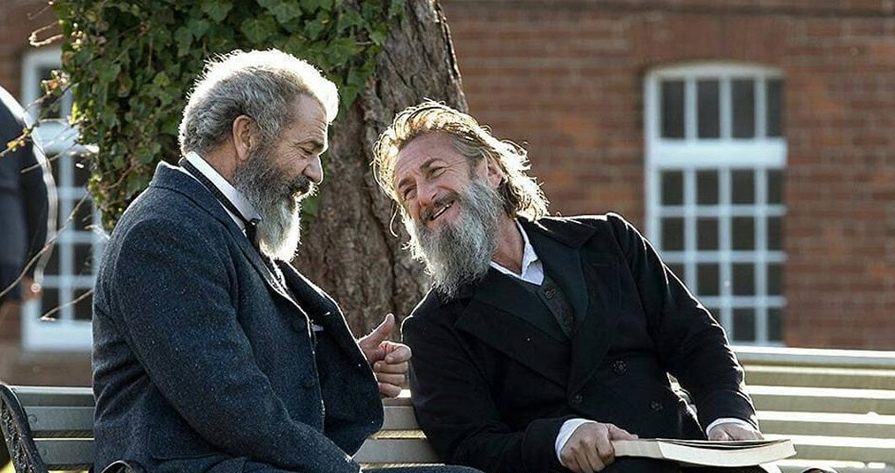
The Professor and the Madman is not a decent film for a whole range of reasons - which, because they include Sean Penn seemingly cutting off his own dick, I will most definitely be going into later on - but a big part of it is that Mel Gibson is trying to replace how the public sees him with how he sees himself. Last year's Dragged Across Concrete worked in large part because there Gibson was playing an angry racist. Here? He's a living saint.
Based on the true story of how the Oxford English Dictionary came to be, one of the many problems this film has is that while a while lot of things take place, very few of them join up to form a story. Professor James Murray (Gibson) is a Scottish school teacher who's religious, well-mannered, a loving husband and caring father, and a man passionately devoted to language: who better to take over Oxford university's struggling dictionary project?
Meanwhile, former US Army surgeon turned crazed murderer Dr William Minor (Sean Penn) is acting crazy at Broadmoor Criminal Lunatic Asylum, where he's been sent after murdering the husband of Eliza Merrett (Natalie Dormer). There he saves the life of a guard impaled on a faulty gate, decides he wants his army pension sent to Merrett to make amens for his crime, and then really gets into helping out Murray (whose big idea to get the dictionary done is to ask the public for help).
Conflicts between director Farhad Safinia (who's had his name taken off the film) and the producers meant this has been sitting on a shelf since 2016, and the end result has some definite rough edges in editing (plus a couple of establishing shots seemingly shot on a handicam from 2004).
But not even a skilled editor could make Penn's massively over the top performance belong alongside everyone else, or change the way that Steve Coogan's character (Murray's biggest supporter) literally just shows up at multiple points to say "I have a cunning plan" and then saves the day via some off-camera scheme. Did I mention Minor ends up teaching Merrett how to read?
It'd be tempting to say the film's biggest mistake comes when Minor - suddenly tormented by his budding romance with the wife of the man he killed - rips a metal strip from a chair and uses it to (tastefully) do something that results in him bleeding profusely from the groin. But does he actually cut off his dick? Whatever he does lop off kills the romance stone dead so it seems safe to guess he's now coming up short in the downstairs department. Did this happen in real life? No. Why did anyone think it was a good idea to put it in the movie? Well, it does star Mel Gibson.
Annoyingly, it's hard to deny that Gibson remains a strong and charismatic actor. He's easily the best thing here as the films moral centre, a man who sticks by his principles, stays true to his friends, consults his wife on all major decisions, clearly loves his children, is well read without being arrogant, is a firm but thoughtful leader and so on and so forth.
But in 2020 the fact that Gibson is an angry man with a dark side he can't hide is so firmly ingrained in the public consciousness - when the public bothers to think of him at all; if being an abusive drunk hadn't killed his career a decade ago his star would probably still be on the wane today - that his warm and kindly performance here feels like the set up for a joke that never comes.
- Anthony Morris
Based on the true story of how the Oxford English Dictionary came to be, one of the many problems this film has is that while a while lot of things take place, very few of them join up to form a story. Professor James Murray (Gibson) is a Scottish school teacher who's religious, well-mannered, a loving husband and caring father, and a man passionately devoted to language: who better to take over Oxford university's struggling dictionary project?
Meanwhile, former US Army surgeon turned crazed murderer Dr William Minor (Sean Penn) is acting crazy at Broadmoor Criminal Lunatic Asylum, where he's been sent after murdering the husband of Eliza Merrett (Natalie Dormer). There he saves the life of a guard impaled on a faulty gate, decides he wants his army pension sent to Merrett to make amens for his crime, and then really gets into helping out Murray (whose big idea to get the dictionary done is to ask the public for help).
Conflicts between director Farhad Safinia (who's had his name taken off the film) and the producers meant this has been sitting on a shelf since 2016, and the end result has some definite rough edges in editing (plus a couple of establishing shots seemingly shot on a handicam from 2004).
But not even a skilled editor could make Penn's massively over the top performance belong alongside everyone else, or change the way that Steve Coogan's character (Murray's biggest supporter) literally just shows up at multiple points to say "I have a cunning plan" and then saves the day via some off-camera scheme. Did I mention Minor ends up teaching Merrett how to read?
It'd be tempting to say the film's biggest mistake comes when Minor - suddenly tormented by his budding romance with the wife of the man he killed - rips a metal strip from a chair and uses it to (tastefully) do something that results in him bleeding profusely from the groin. But does he actually cut off his dick? Whatever he does lop off kills the romance stone dead so it seems safe to guess he's now coming up short in the downstairs department. Did this happen in real life? No. Why did anyone think it was a good idea to put it in the movie? Well, it does star Mel Gibson.
Annoyingly, it's hard to deny that Gibson remains a strong and charismatic actor. He's easily the best thing here as the films moral centre, a man who sticks by his principles, stays true to his friends, consults his wife on all major decisions, clearly loves his children, is well read without being arrogant, is a firm but thoughtful leader and so on and so forth.
But in 2020 the fact that Gibson is an angry man with a dark side he can't hide is so firmly ingrained in the public consciousness - when the public bothers to think of him at all; if being an abusive drunk hadn't killed his career a decade ago his star would probably still be on the wane today - that his warm and kindly performance here feels like the set up for a joke that never comes.
- Anthony Morris
Thursday, 13 February 2020
Review: Sonic the Hedgehog
Remember that creepy weird Sonic the Hedgehog design that so freaked out fans this movie was put back three months while the film's effects department went through the entire film and reworked the CGI character to be less... spindly? Out went the smaller eyes and long legs, in came the more compact and cartoony version fans love?
Watching the finished movie, that original design makes sense: this Sonic is, for most of the movie at least, an awkward, hyperactive teen trying to figure out if he has a place in the world. It makes sense that he'd look a bit off; then again, he also looked a bit off, and the new and improved version is a lot closer to the super-fast blue alien hedgehog we all know and possibly have feelings towards.
(the original model Sonic - note the legs and tiny face)
Opening mid-explosion in the kind of "that's me - Sonic. Bet you're wondering how I got into this predicament" introduction that even the kids this is aimed at have seen too many times, this rushes through Sonic's origin (alien raised by an Owl, has magic teleporting rings, is sent to Earth to hide out, is given the not at all psychological damaging advice of "never stop running") to get to the status quo: he lives in a cave of the outskirts of the small town of Green Hills, where he spies on everyone and talks to himself in an attempt to prevent the isolation from driving him insane. Good luck with that.
James Marsden was having a bit of a career comeback when he signed on for the role of local cop Tom Wachowski, so that's probably over now. But he remains the most likable man in Hollywood and brings a lot of charm to a largely thankless role as firstly a bored cop and then secondly a surrogate parent to Sonic after an emotional outburst from the depressed and frustrated hedgehog results in an energy burst that attracts the attention of the US military's most unhinged drone pilot, Doctor Robotnik (Jim Carrey).
Carrey is doing a greatest hits tour here, dusting off all the old tics and antics that made him a star twenty five years ago. The good news is they still work, putting the film in the awkward position of having its star hedgehog as the weakest performance in the film. But there are a bunch of decent speed-related action sequences, and Sonic's emotional arc - he knows he should flee the planet but his next stop is a lifeless mushroom planet and he can't keep living alone and on the run - is strong enough to hold everything together.
This is much more aimed purely at kids than last year's Detective Pikachu, and it moves fast enough (sorry) to keep them entertained while the grown ups wonder why Marsden doesn't get better roles. The ending leaves the door open for at least one sequel, though there's nothing much here that'll leave you wanting more; guess Sonic'll have to be happy with the games and comics and TV series and collectable figures and hoodies and phone cases and whatever else the Sega official store is selling this week.
- Anthony Morris
Thursday, 6 February 2020
Review: Birds of Prey
It's always a surprise when a superhero movie turns out to be good. That's because most superhero movies are more like Birds of Prey: just erratic and uneven enough to leave you feeling vaguely unsatisfied, even if most of the elements for a decent film are present and accounted for. It's not hard to be better than predecessor Suicide Squad (and this is), but DC haven't cracked the formula for a successful ensemble film just yet.
The hook here is that this is girls versus boys, straight down the line; the days when this kind of film would have a wimpy guy on the good girls team, or the bad guy would have a female assassin so the girls had someone to fight are over. This battle of the sexes works better than something like last year's all-female gangster film The Kitchen did, mostly because the superhero genre is literally about empowerment fantasies - even if Margot Robbie's now-single Harley Quinn is largely a quirky, garish bad guy who snorts cocaine mid-fight to level up.
(she does get something of a redemption arc, but it's slight: you don't make money changing a successful superhero)
Quinn is the lead here, with bad guy Black Mask / Roman Sionis (Ewan McGregor) in second place camping it up entertainingly when he's not having faces removed or ordering a terrified guest in his club to dance on a table while her date is forced to peel her dress off with a knife. The rest of Quinn's girl gang - Diana / Black Canary (Jurnee Smollet-Bell), Detective Renee Montoya (Rosie Perez), Huntress (Mary Elizabeth Winstead) and Cassandra Cain (Ella Jay Basco) - tend to get one character trait each, some of which work better than others. Montoya's 80's cop movie banter falls flat every time, while Huntress' failure to maintain her stern avenger persona is fun.
A movie that contains five - six if you count the main bad guy - origin stories is bound to have a lot going on in the script department. Sensibly, the actual plot is extremely straightforward: everyone wants a diamond that has a bunch of bank account details laser-coded into it, and when a character swallows it then we have a reason for this search across a somewhat gritty Gotham (it's like a sunnier version of the city seen in Joker) to run movie length as the good guys wait for it to be pooped out while keeping the swallower away from the bad guys willing to just cut it out.
(is there an article to be written about movies that use someone swallowing the mcguffin as an excuse to drag things out? It feels like there is)
What is a surprise is that so much of the story is a mess. Initially Quinn is telling it and her unbalanced state of mind after being dumped by the (unseen) Joker kind of justifies the going back and forth, but there's a reason why opening a movie mid-action then freeze-framing while a narrator says "let me explain how I got here" is a comedy cliche, and this does that more than once.
All this ducking and weaving eventually settles down, but this definitely feels like a film that's had a going-over in the edit. The multiple origin stories are either told piecemeal or repeatedly, characters are introduced more than once, other characters are built up then vanish (what happened to the DA?), and the "birds of prey" don't even get together until the final act. While none of this is exactly fatal, if this is trying to sweep an audience along on sheer energy alone then it's not exactly Goodfellas.
The good news is that this does get right the only things we really care about in superhero movies: the characters are mostly memorable and the fights are largely entertaining. Not all the cast get a real chance to shine - this probably could have lost at least one Birds of Prey team member, especially as their girl gang chemistry isn't great - and the fights occasionally feel a little samey, but by the final act it's all settled into a groove that's solidly, if not all that spectacularly, entertaining.
- Anthony Morris
The hook here is that this is girls versus boys, straight down the line; the days when this kind of film would have a wimpy guy on the good girls team, or the bad guy would have a female assassin so the girls had someone to fight are over. This battle of the sexes works better than something like last year's all-female gangster film The Kitchen did, mostly because the superhero genre is literally about empowerment fantasies - even if Margot Robbie's now-single Harley Quinn is largely a quirky, garish bad guy who snorts cocaine mid-fight to level up.
(she does get something of a redemption arc, but it's slight: you don't make money changing a successful superhero)
Quinn is the lead here, with bad guy Black Mask / Roman Sionis (Ewan McGregor) in second place camping it up entertainingly when he's not having faces removed or ordering a terrified guest in his club to dance on a table while her date is forced to peel her dress off with a knife. The rest of Quinn's girl gang - Diana / Black Canary (Jurnee Smollet-Bell), Detective Renee Montoya (Rosie Perez), Huntress (Mary Elizabeth Winstead) and Cassandra Cain (Ella Jay Basco) - tend to get one character trait each, some of which work better than others. Montoya's 80's cop movie banter falls flat every time, while Huntress' failure to maintain her stern avenger persona is fun.
A movie that contains five - six if you count the main bad guy - origin stories is bound to have a lot going on in the script department. Sensibly, the actual plot is extremely straightforward: everyone wants a diamond that has a bunch of bank account details laser-coded into it, and when a character swallows it then we have a reason for this search across a somewhat gritty Gotham (it's like a sunnier version of the city seen in Joker) to run movie length as the good guys wait for it to be pooped out while keeping the swallower away from the bad guys willing to just cut it out.
(is there an article to be written about movies that use someone swallowing the mcguffin as an excuse to drag things out? It feels like there is)
What is a surprise is that so much of the story is a mess. Initially Quinn is telling it and her unbalanced state of mind after being dumped by the (unseen) Joker kind of justifies the going back and forth, but there's a reason why opening a movie mid-action then freeze-framing while a narrator says "let me explain how I got here" is a comedy cliche, and this does that more than once.
All this ducking and weaving eventually settles down, but this definitely feels like a film that's had a going-over in the edit. The multiple origin stories are either told piecemeal or repeatedly, characters are introduced more than once, other characters are built up then vanish (what happened to the DA?), and the "birds of prey" don't even get together until the final act. While none of this is exactly fatal, if this is trying to sweep an audience along on sheer energy alone then it's not exactly Goodfellas.
The good news is that this does get right the only things we really care about in superhero movies: the characters are mostly memorable and the fights are largely entertaining. Not all the cast get a real chance to shine - this probably could have lost at least one Birds of Prey team member, especially as their girl gang chemistry isn't great - and the fights occasionally feel a little samey, but by the final act it's all settled into a groove that's solidly, if not all that spectacularly, entertaining.
- Anthony Morris
Subscribe to:
Posts (Atom)