Search This Blog

Wednesday, 25 April 2018

Review: Avengers: Infinity War


Usually when critics complain that a blockbuster lacks things like character development or decent plotting or a satisfying resolution, what they're really doing is revealing that they have no idea what a modern blockbuster is meant to do. This isn't a slam on critics of Avengers: Infinity War - it's definitely a film with problems, even judged on its own terms - but this kind of film is bought and sold as spectacle first and foremost, and complaining that it isn't narratively satisfying largely misses the point.

The hook here is that this is the culmination of the last decade of Marvel movies, all 19 of them.  Obviously it's not: Marvel is great at leaving plot threads dangling at the end of one film and ignoring them in the next (were any of the plot points at the end of Captain America: Civil War ever mentioned again?). It's just another "everyone teams up to fight a really big bad guy" movie, and while it delivers on the "big", the "fight" side leaves a bit to be desired.

The story contains a lot of moving parts around a very simple core: giant space bad guy Thanos (a CGI'd Josh Brolin), who has spent the last six years since he had a cameo in the first Avengers movie doing very little, has finally decided to wrap up his quest for the Infinity Stones - six magic gems that when put together into the Infinity Gauntlet will enable him to kill off half the universe. As these gems are scattered across the universe (well, two are on Earth, which is handy), Thanos and his underlings make a variety of largely self-contained attempts to get ahold of them. That means despite the extremely large cast of characters -

- which would be Iron Man (Robert Downey Jr), Thor (Chris Hemsworth), Spider-Man (Tom Holland), Bruce Banner / The Hulk (Mark Ruffalo), Dr. Strange (Benedict Cumberbatch), Steve Rogers / Captain America (Chris Evans), War Machine (Don Cheadle), Star-Lord (Chris Pratt, Vision (Paul Bettany), Black Panther (Chadwick Boseman), Gamora (Zoe Saldana), Black Widow (Scarlett Johansson), Scarlet Witch (Elizabeth Olsen), Groot (the voice of Vin Diesel) and Rocket (the voice of Bradley Cooper), among others -

- most of them are clumped together in relatively manageable groups for their individual clashes with Thanos. Which makes him the central character here, a move that works largely thanks to a strong performance from Brolin as a bad guy who's more heartfelt true believer (in mass murder) than the usual power-for-powers-sake super villain. 

As what is basically a "greatest hits" showcase aimed at an audience excited simply to see Spider-Man and Star Lord in the same frame, some characters are served better than others. Iron Man gets a lot to do, which isn't surprising as he's probably on the way out; Steve Rogers doesn't get much, though maybe they're holding him back for the sequel. One note characters (Spider-Man, Star Lord) generally fare better than others with the limited space available, though both Dr Strange and The Vision are surprisingly central. It's no spoiler to say that not everyone makes it out of this alive, and that some deaths are clearly more permanent than others; part of the skill in putting this sort of film together is to know when a character's role is finished and they can be taken off the board.

(this does mean the characters with no story tend to stand out in a "huh, are you still here?" way. Everyone in Steve Rogers' crew is surplus to requirements; Wakanda seems to have been chosen as the site for a big fight largely because that way no civilians will be hurt - it's definitely not because they thought of anything interesting to do with Black Panther)

Despite having directed what is generally considered to be one of the more cinematic Marvel movies in Captain America: The Winter Soldier, directors Anthony and Joe Russo flub just about every fight scene here, reducing every battle to a murky blur of pummeling without style or flair between dozens of combatants who all either punch or fire energy beams. One area where the much-derided DC superhero movies have it over Marvel is an awareness that their characters' differing superpowers are what makes them interesting, so the fights are a chance to show them off; here Dr Strange's mystical powers or Scarlet Witch's magic just involve shooting and shielding like everyone else (except for the characters who punch people).

Many of the elements critics complain that these films are lacking are missing for a reason. The point of these films is to show off the characters - the more the merrier - making one-off moments that show off a character's core (marketable) attributes more important than traditional story-telling. Unfortunately, most of Marvel's characters' core attributes revolve around an ability to make quips at serious moments, so making the joke-free Thanos the lead was a wise move. Still, feeling like a series of intercut commercials for action figures isn't a bug; it's a feature. Despite the massive cast (and a couple of main Marvel characters are explicitly excluded) this still manages to remind us that there are still more new characters coming up from Marvel.

But fight scenes are the core rationale of this kind of blockbuster, and that's where this falls over. We're here to see Marvel mash all of their toys together, and when the mashing side of things is plodding and uninspired then the film as a film - as separate from the film as a chance to see your favourite characters meet up, or to test your deep cut Marvel Universe knowledge, or to see Stan Lee for what must surely be close to the last time - can't be considered a success. Superheroes live to fight, and marketing means they'll never die; it's only when the viewers lose interest that their existence is in any real danger.

Thursday, 19 April 2018

Review: I Feel Pretty

Amy Schumer plays a woman whose life is turned around when she suddenly and irrationally becomes convinced she’s gorgeous; it's not exactly the most sure-fire concept for a movie in 2018, even if you haven't been reading the various "Amy Schumer's 'I Feel Pretty' is offending women" articles doing the rounds. 

But in bad news for outrage fans, the problem here has more to do with the marketing - Hollywood isn't great when it comes to selling comedies as anything more than crass high concepts - than the film itself; it turns out I Feel Pretty (okay, the title doesn't help) is actually a film in which Amy Schumer plays a woman whose life is turned around when she suddenly and irrationally becomes imbued with the kind of self-confidence most people would kill for.

Yes, the film initially focuses on how fashion world underling Renee Bennet (Schumer) is bummed out by her looks – but it’s clear as she struggles through her day that the real problem isn’t how she looks, but how she feels about those looks. So when a combination of a wish and a bump on the head has her thinking she’s a perfect 10 (importantly, it’s all in her head – there’s no scene where we see a fantasy version of her), it’s the new confidence this gives her that’s the real change. Now she’s going after her dream guy and her dream job, and nothing and nobody is going to stand in her way.

Unsurprisingly in 2018, this is extremely careful to focus on the empowering side of her condition. Even the side characters who you'd expect to be carrying much of the comedy workload - especially Michelle Williams as the hilariously soft-voiced boss of a fashion and make-up empire she's recently taken over from her watchful grandmother (Lauren Hutton) - end up being given a positive spin; those after snarky laughs (even at the expense of skinny models) will come away disappointed.

Being warmly funny rather than side-splitting (the running joke here is that Renee's confidence wins over people no matter what iffy situation she dives into, up to and including a wet t-shirt contest), this constantly threatens to become a blandly insipid rejoinder to numerous meaner films - Shallow Hal is usually mentioned somewhere around here. Hollywood comedies may be increasingly socially aware, but they're yet to come up with ways to make that awareness consistently funny; treating everyone with respect and consideration is an admirable goal, but as the basis for a high concept comedy "everyone gets along" is a tough sell.

Fortunately Schumer, playing a character that’s pretty much sweetness personified, makes Renee someone it’s impossible not to cheer for.  That also makes the extremely predictable third act fall flat: the main thing this film has going for it is seeing Schumer as a charming go-getter, and when that's gone this comes crashing to earth. Still, this is pretty much feel-good film-making personified (the only real bad guy is Renee’s lack of confidence); it’s so firmly committed to doing the right thing that wishing it might have been sharper or funnier just seems mean. 

Anthony Morris
-->

Thursday, 12 April 2018

Review: Truth or Dare


"Horror" is a label that covers a wide variety of movies. Some, like the current A Quiet Place, are all about expressing a scary concept as purely as possible; others, like Get Out, use horror as a way to crack open wider issues. And then there are the ones where dumb but sexy people get killed off one by one. That's Truth or Dare. It's not very good.

To be fair, parts of Truth or Dare aren't all that bad, even if the story isn't exactly promising. When a group of uni students led by Olivia (Lucy Hale), each with their own various personal quirks (one's a drunk, one's a med student selling drugs on the side, there's a love triangle, etc), go on spring break to Mexico, they end up in a creepy abandoned mission playing truth or dare with a stranger who then reveals they're now all cursed to play the game until they die. They go home, forget about it, and then they start to die.

The basic idea - that instead of possessing a person or place, a demon has possessed a game of Truth or Dare - isn't automatically a bad one, even if throwing in previously un-mentioned rule changes half way through isn't great and the "messed-up snapchat filter" face the demon gives people when speaking through them ranges from slightly creepy to downright laughable. The plus is the demon is attacking the bland teens on two fronts; either they do some stupid prank that'll probably get them killed, or they have to say something horrifically hurtful or dangerous. Unfortunately, their personal issues are largely out of The Bumper Book of Soap Opera Cliches; these are persons with no personality.

(shout out to Ronnie, the douchebag who appears out of nowhere to insert himself uninvited into the cool kids' Mexico spring break, does nothing but hit on every women on screen, and is the first to die. Guys like him are never the main focus, but they're always the most entertaining to watch)

These films are all about the set pieces and there are a handful of mildly effective ones here, including one that's more about causing emotional harm than throwing someone off a roof - in a rarity for modern teen horror, this actually has a (fairly chaste) sex scene between main characters that we get to see, though things don't go quite as the couple planned. But the straight-up kills are nothing special, while characters are too generic for the personal reveals to hit home; the various twists around a closeted character with a homophobic cop dad are presumably meant to be surprising and heartfelt, but just come off as the least possible effort to avoid the most obvious outcome.

A fast pace is this fizzle of a film's biggest asset. By the time it becomes clear that the initial promise of the premise isn't going to be lived up to - Ronnie's death isn't a classic, but it does suggest that the demon is going to serve up some memorable kills - we're (barely) invested enough in the characters' personal quirks to make the dull fatalities (barely) less than a deal-breaker. And by the time it's clear that the characters will always be two dimensional cut-outs, the end is in sight.

Just make sure you stay for the most hilariously rubbish green-screen "special effect" in recent cinema history - presumably the killer demon dared the film-makers to include it.

Anthony Morris

Thursday, 5 April 2018

Review: A Quiet Place


Less is usually more when it comes to horror. Nightmares don't require extensive backstories and lengthy explanations to scare the crap out of you. But turning a scary idea into a scary film is harder than it looks, and even when the idea seems sure-fire sustaining tension for an entire movie is something not even the best directors can pull off.

So while A Quiet Place isn't as fun or as memorable as many of the classic horror films of recent years, the one thing it is - and it's the one thing that makes it a must-see for horror fans - is relentlessly, brutally scary. There's no jokes, no snappy dialogue (there's almost no dialogue at all), the bare minimum of character development and what backstory there is you can get by just fine without. It's ruthless when it comes to cranking up tension; this is the rare film where the people around me (and yes, me too) were flinching at literally everything by the final half hour.

What if there were supremely lethal monsters everywhere and the only thing that attracted them to you was sound? It’s day 89 of this unpleasant situation, society has crumbled, almost everyone is dead and for the Abbott family a quiet trip into town for medicine has a dramatic ending when their youngest takes a shine to a battery-powered toy spaceship.
 
Cut to a year and a half later and life on the Abbott’s farm remains on a knife-edge: Lee (John Krasinski, who also directs) is working on building a working hearing aid for deaf daughter Regan (Millicent Simmonds, who's deaf in real life), who blames herself for what happened to her youngest brother. That makes her other brother Marcus (Noah Jupe) sad, while their mother Evelyn (Emily Blunt) is very pregnant. But mostly they remain very, very quiet (and talk with sign language), which means that any loud noise is jarring to hear (for the audience) and potentially fatal (for the family). 
 
Often films like this run through their ideas and fizzle out before the end. A Quiet Place doesn't have a whole lot of ideas - and some are never really explored; surely someone who was deaf would be more at risk of accidentally making a loud noise? - but Krasinski does an excellent job of wringing every possible drop of tension from them. Floorboards are noisy; giving birth is noisy; impaling your foot on a nail is noisy. Once that's been established, it's just a matter of making us squirm while we wait for the inevitable.

Much of what makes this drawn-out drama suspenseful rather than frustrating is the way it doesn't cheat. Making a sound is a fatal mistake, but it's one that's very easy to make. Walking around barefoot might not be the best idea, but in a world where sound equals death it's a reasonable choice to make; likewise when you've lost one young child deciding to have another is understandable even if babies aren't exactly known for their stealthy qualities.

But this wouldn't be half as effective without the performances. Krasinski honed his silent acting on nine seasons of The Office, and he puts those face-pulling skills to good use here as a man struggling to hold it together. Blunt is even better, but they're both outshone by Simmonds, who becomes the emotional core of the film without speaking a word. Her performance cranks up the tension even further; when someone this good is on screen, everyone else is expendable.

Anthony Morris


Thursday, 29 March 2018

Review: Ready Player One


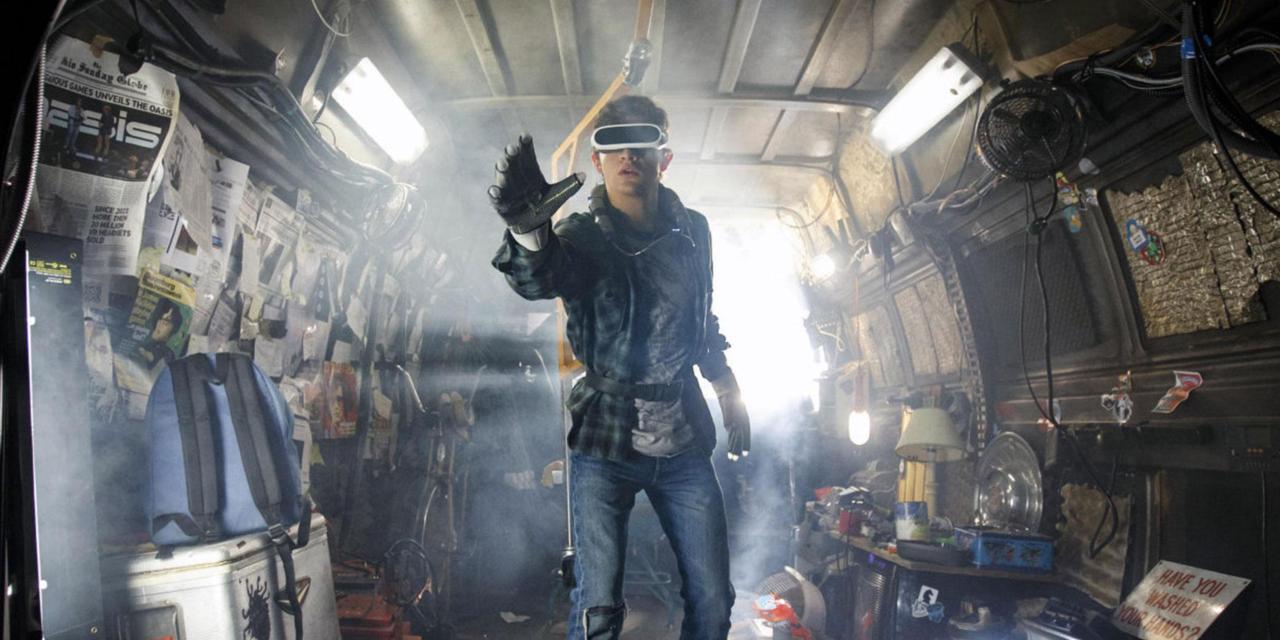
Often the most interesting thing about a movie is the thing they don't want you paying attention to. When you're setting up an extreme scenario that you want to play around with, usually the easy thing to do is to set up an environment where that scenario seems reasonable; there's a reason why crime rules the streets in every Death Wish movie. So to have everyone constantly logged into a virtual world in Ready Player One, the real world has to be a crapsack. But why?

Movies have always struggled to make virtual worlds interesting. Movies themselves are a virtual world we willingly enter; add another layer to that and you run the risk of the audience feeling too far removed from the story. Inception made it work by having the layers of removal be part of the story; The Matrix set the bar impossibly high by making the virtual world the only place where the characters could be fully human. And here? It's important because that's where all the cool stuff is.

The original novel had a little more to it thanks to its creepy obsession with 80s pop culture. Emotionally it made sense: of course people are going to use virtual and augmented reality to escape into their obsessions, and of course people reading a novel in 2011 are going to know about and be nostalgic for 80s pop culture (people in the novel's setting of 2045 not so much, but that's what the scavenger hunt angle is for). Nostalgia is a dead end, but at least the book foregrounded it so much it couldn't help but make that obvious, even as it worshiped a past we can never return to.

Director Steven Spielberg, on the other hand, clearly couldn't give a shit. If he wants to get nostalgic for pop culture that means something to him, he can churn out another Indiana Jones movie. So the novel's focus on 80s pop culture as a way to solve the scavenger hunt for the keys to rule the Oasis instead becomes a much more general "pop culture" angle where the scavenger hunt problems are instead solved by focusing on the life of the Oasis' creator.  The references are much more general: The Iron Giant, which gets a lot of play in the marketing, is a 90s reference (just), while more recent games like Halo and Overwatch also get a look in - and the virtual world of the Oasis becomes a kind of pop culture junkheap without even the bonds of nostalgia to hold it together.

(presumably this is why a bunch of negative reviews have ended with movie quotes, as if to say "this is how to re-use pop culture, old man" - the problem for some reviewers isn't that this film is a celebration of nostalgia, it's that it doesn't celebrate nostalgia enough)

This version of the Oasis isn't even interesting on a "nerd showing you his action figures collection" level: at least those action figures mean something specific to one particular nerd. And with much of the "action" in the Oasis consisting of virtual characters just hanging out (which might have been fun when you were playing World of Warcraft but was as boring as hell to anyone watching you play) the narrative focus of the film drifts just enough to make the outside world seem worth a look. Which is a problem, because in this story the outside world is meant to be the frame, not the picture.

In 2045 everything has to be crap, because otherwise why would everyone spend all their time online? There's not even a hint of the much more likely reason: everything is crap because everyone spends all their time online. There's nothing more out-of-touch than an old man complaining that kids need to get outside and play more, so this is extremely careful not to even hint that cause and effect could work the other way. Our heroes would totally be out there changing the world, if only the world was worth changing.

Ready Player One sets up a virtual world that's a pile of random pop culture references thrown together into a meaningless junk heap, and then says that's the only escape from a real world that's a literal junk heap. The idea of there being anything to life beyond "I gotta get what's mine" has vanished; the biggest struggle is over who gets to run the world's biggest message board, only nobody has anything they want to say.

The real nostalgia here is for a time when nostalgia was possible, a world where things meant something and everything wasn't happening to everyone all the time. It's a film about a civilisation that's given up on both meaning and the future: Spielberg must be a whole lot of fun at parties these days.

Friday, 23 March 2018

Review: Mary Magdalene


Mary Magdalene is a quiet and sensitive film about a radical woman. Lacking the violent bombast of most biblical filmic narratives, and refusing to answer many of the questions it raises, it's a film that may perplex or underwhelm impatient audiences. But it's interesting precisely because of this quietness, and for the way it allows its central character, Mary (Rooney Mara, etherial and serious), a spiritual journey that's valid and plausible, whether or not you can believe in the mumbling Jesus  as the son of God or merely a gifted guru ahead of his times. This is a film that arguably allows both possibilities to exist side by side.

We first meet Mary as an empathic young woman living in a small fishing village where she doesn’t fit in with her traditional male-dominated Jewish family. She doesn’t want to marry or bear children and yearns for something intangible. Her independences leaves her open to accusations of demon possession and there are moments of real danger in the way her male relatives try to deal with this rebellion. But when she meets the travelling teacher (Joaquin Phoenix) and his band of disciples, she joins their radical social movement, travelling along the dusty roads to Jerusalem where Jesus meets his cross.

Written by Helen Edmundson and Philippa Goslett, and produced by the UK/Australian team who made The King’s Speech, Mary Magdalene is the second feature from director Garth Davis, who directed the sweeping and crowd-pleasing Lion (2016). As a viewer raised an Evangelical Christian and fed the gospel stories along with my mother's milk, it was a blessed relief to watch the way this film skips the well-worn greatest hits of the Jesus album – or at least comes at them from a side angle, only showing what Mary herself might have witnessed. The bickering and power plays between the male disciples are also convincing and well drawn (particular highlights include Chiwetel Ejiofor as Peter and Tahar Rahim as a sympathetic Judas Iscariot). These conflicts point towards the reason why Mary Magdalene has been sidelined in historical accounts and misrepresented (by the early Catholic church) as a prostitute. There's  nothing at all carnal in this re-telling, not even a smidgen of romance. And that's a relief.

Mary Magdalene is committed to showing the extreme simplicity and poverty of its times and setting: the labour involved in netting fish, drawing water or birthing babies, and the casual brutality of Roman occupation. Production design by Fiona Crombie and costumes by Jacqueline Durran emphasise the homespun beige calico and burlap world of the characters, though Greig Fraser's gauzy, gorgeous cinematography gives radiance to the stripped back palette.

There are moments here that feel too quiet, too slow. And Phoenix's Jesus is frankly underwhelming. With matted beard, and looking far older than the 33-year-old historical Messiah, his barely projected sermons and understated 'miracles' of healing are never quite as impressive as the gospels might have us believe. This Jesus suffers from palpable confusion and even self-doubt. And yet perhaps that's point. The real Jesus failed to fulfil the expectations of those who longed for a politicised revolutionary. And yet the revolution he undoubtedly started continues to shape the world, for better or worse. In Mary's escape from domesticity into the life of a religious follower, we see the birth of an escape route open to women in the midst of repressive patriarchal societies - the life of a nun who's allowed to evade biological destiny and pursue a calling more cerebral.


Thursday, 15 March 2018

Review: Tomb Raider


Tomb Raider is an old-fashioned film, and not just because a large chunk of it takes place in a thousand year-old crypt: there’s next to nothing going on in this largely unambitious action-adventure that you couldn’t see in a movie twenty (forty?) years ago. Well, maybe one thing: at a time when the idea that simply taking another culture’s relics is a little dubious, the new Tomb Raider goes out of its way to present grave-robbing in a socially acceptable light. This time around the ones actually robbing the tomb are the bad guys, the tomb is Japanese (relatively safe to pillage culturally speaking) and it's also pretty much a death trap the Japanese didn’t want anywhere near their country anyway.

So with that safely taken care of, we’re free to enjoy the tomb-raiding clichés – of which there are many, and this gleefully includes all of them – under the steady leadership of Alicia Vikander, who as Lara Croft delivers a performance that gives just the right amount of emotional heft and intensity to all the running, jumping, crawling, diving, more jumping, arrow-shooting, bike racing, kick-boxing, swimming, and falling out of the sky. Not only is Croft not a superhero, she’s not an experienced adventurer: this is her origin story, and it’s refreshing to see her be exasperated or freaked out by the kind of rough and tumble that a more experienced heroine (or less engaged actor) would take in her stride.

Taking its lead from the successful 2013 reboot of the game, here Croft is 21, a London bike courier, and actively avoiding taking on the mantle (and vast wealth) left to her by her father, Lord Croft (Dominic West). He vanished seven years ago on a vague and mysterious quest to prevent the bad guys – an organisation named Trinity – from finding something evil, and when Croft decides to finally sign the papers that’ll officially mark her father as dead she stumbles upon a clue that inspires her to go looking for him one final time.

This isn’t particularly jet-setting, with only a brief stop-over in Hong Kong for a thrilling but superfluous foot chase scene before she’s off with drunken sailor Lu Ren (Daniel Wu) to find the mysterious island where both her father and his vanished. It’s hardly a spoiler to reveal finding the island is both surprisingly easy and extremely hazardous, and that once there the somewhat unhinged Mathias Vogel (Walton Goggins) is running the kind of archaeological dig where sloppy workers get shot.

For a story that basically runs on rails there are enough twists here to keep things moderately fresh, but who’s watching a Tomb Raider movie for the story? Norwegian director Roar Uthaug strings together an entertainingly varied range of action sequences to keep the excitement levels up before they get into the tomb (even if, as is common these days, the quality of the CGI is variable). 

Once there he manages to make the fairly clichéd and uninspired run of death traps seem more like a camp reunion with some old favourites – spikes! pits! puzzles! deadly swinging things! – than something we’re meant to be taking fully seriously. It’s definitely not a high point of the film, but it’s a Tomb Raider movie; if there isn’t some old school breaking and entering then what’s the point?

The “jungle adventure” genre has been having a mini-revival of late (remember Jumanji: Welcome to the Jungle?) as something of an antidote to the superhero genre’s increasingly bloated dramas. The best of the Indiana Jones movies remains a peak nobody’s going to be scaling in a hurry, and this isn’t anywhere close: the story is thin, the comedy (largely from a brief appearance from Nick Frost) is so-so and the supporting cast are largely forgettable. But as a rollicking old-fashioned adventure – the kind where going over a waterfall is a serious threat – this is a whole lot of fun. For once, a franchise film ending on a cliffhanger seems totally appropriate.

Anthony Morris