Search This Blog

Monday, 13 September 2010

Matching Jack


For her first feature film in over a decade, director Nadia Tass (Malcolm, The Big Steal) sets herself a hard task: a lightweight comedy about children with leukaemia. Fortunately, pre-teen Jack (Tom Russell) has a pretty good chance of finding a bone marrow donor, thanks to the otherwise dubious blessing of having a father (Richard Roxburgh) who’s spent the last fifteen years cheating on his mother with half of Melbourne.

The numerous scenes where Jack’s mother Marissa (Jacinda Barrett) practically goes door-to-door looking for a bone marrow match from her partner’s endless liaisons are the source of much of this finely balanced film’s humour. They contrast nicely with those involving Irish sailor Connor (James Nesbitt), whose energetic efforts to raise the spirits of his ill son Finn (Kodi Smit-McPhee) may prove more successful in attracting Marissa’ attention. This is a gentle film rather than a hilarious one, but its warm tone goes some way towards smoothing over the occasional clunky moment. A film this character-driven needs truly stand-out performances to hold it together. Fortunately, both Barrett and Smit-McPhee shine. They guide this film’s sometimes wobbly script safely home.

Anthony Morris (this review appeared in Forte #481)

Boy


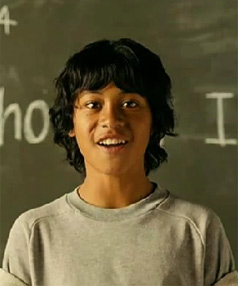
The year is 1984, the place is New Zealand’s Waihau Bay, and for Boy (James Rolleston) life is good. School is out for the holidays, his little brother thinks he has magic powers, and his Grandmother is taking a break for a week, leaving him in charge of a small army of siblings. Then suddenly his long absent father Alamein (writer / director Taika Waititi) drives up with the other two members of his unimpressive bikie “gang”, and Boy’s life is turned on its head.

Waititi’s second film (after the indie comedy Eagle vs Shark) isn’t exactly a coming of age film – it’s smarter and more subtle than that. For audiences trained to think in Hollywood rhythms, the arrival of Alamein – who clearly at least likes his kids, but is also just as clearly mostly there because he buried some money in a nearby paddock and can’t seem to find it – is a cause for dread. The first ten minutes of this film are as funny as anything you’ll see this year, and the return of an absent dad (fresh out of prison to boot) usually signals darker times ahead.

Instead, Alamein proves to be both a better and a worse father than expected, the comedy keeps on coming even when events eventually take on a slightly darker tinge, and the overall impression is one of a film that’s wholly original and totally charming. That’s thanks in large part to the utterly natural performances from the kids and Waititi’s own dorky charisma, and together with a sharp yet daggily funny script they make this a front-runner for comedy of the year.

Anthony Morris (this review appeared in Forte #483)

The Kids Are All Right


Nic (Annette Benning) and Jules (Julianne Moore) may not have a perfect relationship, but it works for them – and for their two kids, Joni (Australia’s own Mia Wasikowska) and Laser (Josh Hutcherson). But with Joni turning 18 (and about to leave home for university) there’s a worm in the apple: she’s now old enough to find out about (and get in contact with) the man who donated the sperm used to create her and her brother. She’s not that interested but Laser needs to know, so they’re introduced to Paul (Mark Ruffalo), the quasi-hippie owner of a wholefoods restaurant. But as Paul – who is a perfectly decent guy – comes further into their lives, fault lines start to appear in the family’s relationships, especially between the controlling Nic and the self-doubting Jules.

Writer / director Lisa Cholodenko (Laurel Canyon, High Art) does an excellent job of constructing her characters and then just letting them crash into each other. It’s rare to see a film that is able to stand as far back from its characters as this one: it’s hardly a ringing endorsement of the touchy-feely personal growth dialogue the adults spout, but there’s still a strong connection with the characters simply as people, no matter what bad or foolish choices they make. Good performances help too (Moore is especially impressive) and its re-creation of upper-middle-class Californian life rings true (and is often very funny). But for the most part this film impresses in the way a well-written novel does: by showing us people we might not like, but who we can understand.

Anthony Morris (this review appeared in Forte #482)

Father of my Children


It doesn’t take long to figure out that Gregoire (Louis-Do de Lencquesaing) is a busy man. Juggling phone calls as he walks and drives the streets of Paris running his film production company Moon films, he’s clearly a man with a lot on his plate. But he also seems to be a warm and caring father and a loving husband – when he’s not on the phone trying to put out one work-related fire or another. Clearly he’s a man passionate about his work and film in general, but as the film progresses it starts to become clear that his juggling act has an increasing sense of desperation to it: money is tight, the business is running on credit that’s running out, and his options are narrowing.

At this point something happens upon which the entire film pivots: without giving too much away, everything changes and yet doesn’t change, as the films story (which, despite the title, turns out to be the story of Moon films rather than Gregoire's family) continues on its way. It’s certainly an interesting angle to take, but it does mean that a lot of the more personal plot threads are left dangling. It’s a look at a man’s life almost entirely through the lens of his work That makes it a somewhat restricted look, and though those restrictions are interesting in themselves, it does make this one of those films where the end is “a new beginning” – a beginning that seems more interesting than the film we just saw.

Anthony Morris (this review appeared in Forte #482)

Sunday, 12 September 2010

Me and Orson Welles


You wouldn’t say that director Richard Linklater’s career has gone off the boil over the last few years, but the low-key run this film – starring Zac Efron, no less – is getting in this country hints at a step down from the days when he was mixing up comedies like School of Rock with lauded arthouse romances like Before Sunset. It’s an impression that Me and Orson Welles never quite manages to dispel: it’s fun, it’s pleasant, it’s engaging, it boasts one powerhouse performance, but it never quite manages to lodge in the memory the way many of his earlier films did.

The year is 1937 and actor Richard Samuels (Efron) scores a bit part in Orson Welles stage production of Julius Caesar. The usual backstage antics ensue thanks to various nutty actors, and before long love blooms between Samuels and Welles’ assistant Sonja Jones (Claire Danes). Problem there is, Welles (Christian McKay) doesn’t like anything going on that he’s not in complete control of. The pace is fast, the tone is light, the whole thing feels well-researched (in part it’s a salute to the hard work that goes into putting on a big performance) and McKay gives an amazing performance as Welles. It just never really adds up to a great deal, and unless you’re a): an Efron fan (he doesn’t exactly move out of his comfort zone, but he’s got charm to spare), b): a theatre buff, or c): interested in Orson Welles, it’s hard to see why you couldn’t wait for DVD here.

Anthony Morris (this review appeared in Forte #480)

Greenberg


Roger Greenberg (Ben Stiller) is not a happy man. Problem is, he doesn’t really have a lot to be unhappy about either: a New Yorker who’s in L.A. to housesit for his well-off brother, despite his blunt nature it doesn’t take him long to start up (and then ruin) a relationship with his brother’s personal assistant Florence (Greta Gerwig).

The more time we spend with Greenberg, the more it seems like he’s driven to ruin whatever good things come his way. He was in a band that almost hit the big time before he knocked back a big record deal, and his friendship with his former bandmate (Rhys Ifans) is uneven at best. Greenberg holds the world to standards that seem fair enough as a teenager but are just annoying as a 40 year old, and his refusal to make a life for himself – rather than the nervous breakdown he seems to have had in New York – seems to be why he’s stuck in the dissatisfying limbo this film displays.

Director Noah Baumbach (The Squid and the Whale) is walking a fine line here, but while Greenberg is largely frustrating as a character the film (based on a script by Baumbach, Jennifer Jason Leigh and Stiller) gives us just enough space to avoid feeling trapped with this strident sourpuss. Stiller is good but not great here – it’s easy to imagine the role being played just as well by a number of actors – but his comedic charm goes a long way towards taking off the edges from a fairly unlikeable character: a better actor would have made this a worse film.

The supporting cast are all excellent, with Gerwig’s finely balanced mix of assertiveness and confusion coming as something of a revelation here as she balances out Greenberg’s studied rejection of pretty much everything with her awkward yet heartfelt refusal to shut herself off. Greenberg might not be that likable, but this often insightful film turns out to have more warmth and humanity than most upbeat “feel-good” comedies can muster.

Anthony Morris (this review appeared in Forte #480)

Centurion


Neil Marshall has a rock-solid track record when it comes to bloody good fun. From his first film Dog Soldiers (their soldiers… and they’re werewolves!) through The Descent and Doomsday, he rarely puts a foot wrong when it comes to serving up quality cheap thrills.

So Centurion might seem at first glance to be something of a chance of pace: based around the story of the Roman Ninth Legion, who marched into the wilds of Scotland in the first century AD and never came back, it sounds like it has at least bone foot based in reality – not an area Marshall’s previous films have had much time for. But here he manages to combine his love of all-action film-making with a thin (occasionally very thin) layer of historical accuracy to create perhaps his most satisfying film to date.

Quintus Dais (Michael Fassbender) is the commander of a small fort on the border between Roman-controlled Britain and the free lands to the north ruled by the Picts, savage tribespeople who don’t fight according to the Roman rules of warfare (and if you think that’s the last parallel this film has to make with the War on Terror, think again). For example, they overrun his fort during a night-time sneak attack, capturing Dais and taking him hostage. Meanwhile, General Virilus (Dominic West, AKA McNulty from The Wire) has been given the job of leading the Ninth Legion north and solving the Pict problem once and for all. The bad news is, the Picts are one step ahead of them all the way; the worst news is, soon Dais is leading a handful of survivors across the barren Scottish highlands as they desperately try to escape a pack of Picts lead by the silent but deadly Etain (Olga Kurylenko) who have sworn to track them down and kill them or die trying.

After the Iraq War analogies (and plenty of severed heads and spurting blood) of the first half, this segues into a tense and single-minded chase film that’s solidly effective despite the occasional cliché (such as jumping off a cliff into a river to avoid capture). The performances pump up the underwritten characters to good effect too, making this one of the best B-grade action thrillers this year.

Anthony Morris (this review appeared in Forte #480)