Search This Blog

Sunday, 2 November 2008

Hunger


In the early 1980s a string of protests rocked Belfast’s Maze Prison as IRA prisoners demanded to be treated as political prisoners and receive special privileges. Their actions included "dirty" protests (refusing to wash, smearing the walls of their cells with their own excrement) and "blanket" protests (refusing to wear anything but a blanket), and eventually escalated to a string of hunger strikes by various members, including the one that led to the death of Bobby Sands (Michael Fassbender). The first half of writer / director Steve McQueen’s film dramatising those events verges on being a silent film, as we see the back-and-forth of the situation: the prison guards living in fear out on the streets, the prisoners being abused inside the prison, with the cycle of abuses ramping itself up to brutal bashings and killings - and then we get what might as well be a twenty minute play filmed pretty much in one take of a conversation between Sands and his priest (Liam Cunningham) which lays out with compelling argument and at times chilling logic the case for Sands calmly starving himself to death. Which we then see him go on to do in the same clinical, almost emotionless detail that the earlier scenes have taken to examine earlier horrors. Hunger is a gripping, utterly absorbing, and at times appalling film that won't be easily forgotten.

Anthony Morris (this review appeared in Forte #440)

Newcastle


There's a fine line between teen angst and being a dickhead and Jesse (Lachlan Buchanan) wanders across it a little too often for Newcastle’s good. Sure, he’s got a lot of problems on his plate. There's his older brother Victor (Reshad Strik) who's moved back home (and turned into a bully) after his pro surfing career ended; a younger brother (Xavier Samuel) everyone calls "Fag-us" (instead of Fergus) because, well, he's clearly gay; and dreams of surfing stardom that’re dashed when he fails to deliver the goods at a qualifying meet. But while everyone else (even the thuggish older brother) gradually develops int a slightly rounded character Jesse remains an angry dickhead, stomping around sulking and moaning and abusing everyone around him. Even when he and his buddies (plus Fergus) go on a camping trip to an isolated surf spot and he finally gets to score with his hot girlfriend he just ends up with even more to be angry about... though this time he has a pretty good reason. Newcastle is well shot (especially in the surf sequences), the cast are convincingly awkward and director Dan Castle’s script certainly has a decent movie buried in there... somewhere. It's probably one about the homosexual awakening of Fergus (easily the most likeable character in the film), as the countless butt shots, the tanned and shirtless cast (the lead doesn’t wear a shirt for the first half-hour of the film - sure, he’s a surfer, but can you name a non-porn film where a female lead wears a bikini for a solid half-hour of camera time?) and the all-male skinny dipping scenes this is one of the gayest “straight” films in recent memory. As it stands, unless you're a huge surfing fan you can keep driving past Newcastle.

Anthony Morris (this review appeared in Forte #440)

How to Lose Friends and Alienate People


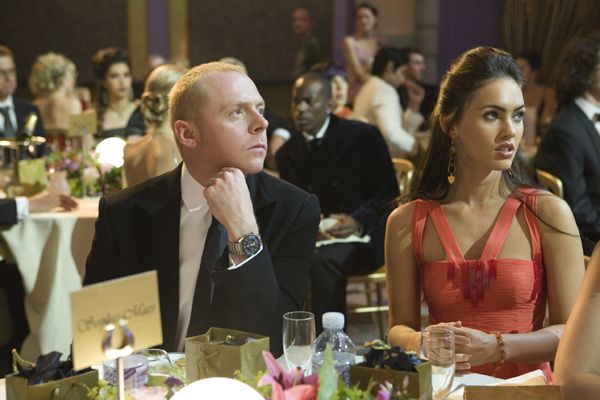
It makes no sense, but it’s true nonetheless: one of the many, many unwritten rules of Hollywood film-making that a romantic comedy is somehow superior to a regular, make-'em-laugh comedy. So we get films like How to Lose Friends and Alienate People, where what should have been a good - or even great - straight-up comedy takes a serious turn for the seriously mushy in the final act. What makes it even more depressing is that up until then the romance angle was extremely well-handled: Sydney Young (Simon Pegg doing a bang-up job) is a feisty, muckraking UK journalist - and, to be honest, a bit of a dick - who gets head-hunted to work for Sharpes magazine in the US. It's a new world for Young, one where publicists control access to the big stars the magazine needs to survive and they use that control to ensure they get favourable coverage. Young, on the other hand, prefers to sink the boots in, which doesn't impress anyone he works with, least of all Alison (Kirsten Dunst). And so for a while what we get is a bunch of very funny workplace pranks and blunders spiced up with some A-list glamour (having hot new actress Megan Fox playing a hot new actress helps a lot in this regard) and Pegg's quality face-pulling, until suddenly the simmering romance between Sydney and Alison is shoved into the foreground, things go sour (as they must in all romantic comedies so the lovers can get back together at the end) and this becomes the extremely thin motivation for Sydney to suddenly throw aside his UK ethics in favour of US-style suck-up journalism. Before long he's got everything but love, but as this is clearly one of those “I had it all, then threw it away for love” stories, the ending isn’t exactly hard to spot. It also makes zero sense when you think about it for even a second - good thing the rest of the film is funny enough to more than make up for it.

Anthony Morris (this review appeared in Forte #439)

Max Payne


Getting the tone right for an action movie is a tricky thing. Even Arnold Schwarzenegger, who got it right more often than most, fell into a serious pit of too-serious seriousness with most of his 90s output. And Max Payne - based on a video game series far more serious than the fun name would suggest - gets it wrong from the get-go. The story itself holds promise: Max (Mark Wahlberg) is a New York cop who's spent three years trying to find his wife's killer, which kinda suggests that he’s not that great a cop. Then suddenly he meets a sexy dame who strips off in his apartment than gets hacked to death after he kicks her out (because the pain of his wife’s death is so strong, not because he’s gay or anything), then his old partner gets hacked to death, then a lot more conspiracy uncovering takes place, and by the end everyone's on drugs and seeing weird stuff. Or something like that - this is one of those films that has too much plot for its own good, especially when everyone's come to see a bunch of cool shoot-outs and instead there's only a handful and they're so packed with cheezy bullet-time you can step outside, get some more popcorn, visit the toilet and come back in before Payne has finished racking his shotgun. As for the grey-scale colour palette and super-sombre tone (does it ever stop snowing?) designed to make us realise this these are serious events - uh, hello? The lead is called MAX PAYNE, not GRIM-FACED DARK AVENGER RACKED WITH SERIOUS EMOTIONAL PAYNE. Good dumb in an action movie is calling your lead Max Payne; bad dumb is what the rest of this film delivers.

Anthony Morris (this review appeared in Forte #438)

The Dutchess


The problem with historical films is that while it’s relatively easy to recreate how people looked back then, it’s a whole lot harder to recreate how they thought. The Duchess is a rare attempt to provide a bit of insight into what was running through the minds of those well-dressed and (by the standards of the time) insanely wealthy types so beloved of costume dramas, and it turns what would otherwise have been a lightweight piece of well-costumed fluff into something that puts a bit of meat onto history’s bones. Still in her teens when wed to the extremely rich and powerful Duke of Devonshire (Ralph Fiennes), Georgina Spencer (Keira Knightley) soon discovers that her husband really only wants one thing from her: a son to carry on the family line. When she turns out to be very good at providing daughters, his attention eventually wanders to her best friend, the recent divorcee Lady Bess Spencer (Hayley Atwell). Unfortunately for Georgina, her attempts to take a lover of her own (Dominic Cooper) are far less socially acceptable...

On the surface this is yet another tale of true love denied by a society bound by unfeeling rules and so on. But while Knightley (who gives one of her better performances as a young woman trapped by her situation) does get to wear a lot of stunning costumes while wandering through some amazing examples of 18th century architecture while waiting to snog her lover, the real centre of interest in this film is The Duke himself. Rather than being a cartoon villain for our heroine to rail against, he’s shown as a man almost as trapped by his role as Georgina is in hers, forced into situations he has little interest in and compelled to act in a certain (usually cruel) way for appearances sake. Fiennes all but makes him a tragic figure, which isn't bad considering he's playing a man who moves his lover into the house he shares with his wife; his performance makes The Duchess far more thoughtful than the average be-wigged costume drama

Anthony Morris (this review appeared in Forte #438)

Sunday, 7 September 2008

Persepolis


It's a good time to be pretentious in the world of comic books. The literary crowd have (finally) embraced "graphic novels" as being the equal of ordinary prose - at least in theory - and the format is still new enough (at least as far as the literary crowd is concerned) to make even so-so projects seem cutting edge. And they have pictures, which is a big plus. So it's not all that surprising that Persepolis made a bit of a splash when it came out a few years ago. The story of a young Iranian woman growing up in the wake of the overthrow of The Shah, it also managed to tick various boxes marked "serious" and "worthy" and - perhaps most important of all post-9/11 when it comes to being marketed towards a western literary crowd looking to understand a people their right-wing leaders were demonising - "middle eastern". Unfortunately, as a biography (and author Marjane Satrapi has said from the start she tweaked some of the facts, though the central character bears her name) it was more down the "informative" than the "insightful" end of the scale. And apart from the fact that the pictures now move, not much has changed with this animated film: characters are thinly developed, the lead is passive and the tone throughout keeps events at a distance, making this a story that all too often feels obviously "told" rather than experienced. That wouldn't matter much if the story was told with flair, but the animation is basic and the pictures lifeless, resulting in a film that gets by because of the novelty of its setting rather than any real artistic achievement. Still, it's an animated film based on a graphic novel about growing up as a woman in a fundamentalist Muslim regime: you can't get more arthouse cred than that.

Anthony Morris (this review appeared in Forte #435)

Saturday, 6 September 2008

Not Quite Hollywood


Once upon a time, not all that long ago, Australian films were entertaining as well as worthy. If you wanted to see well-off people moaning about their problems or poor people griping about their troubles, you could do that - but if you wanted to see people being hunted for sport in the terrifying future world of 2000, that was on offer as well. But in any war the winner gets to write history and when arthouse film took over the local cinemas in the late 80s / early 90s (thanks to a variety of factors, including the demise of the drive-in and changes in taxation), they wrote the entertaining side of Australian cinema out of the history books. Until now: Not Quite Hollywood is both an educational look back at the world of the so-called 'Ozploitation' films of the 70s and 80s and a rip-roaring collection of amazing scenes and sequences from those very same films. It's a double whammy: you not only get a solid history lesson in the dark side of Australian film, complete with countless classic wisecracks from the many, many colourful characters involved (and director Mark Hartley seems to have spoken to everyone who ever made a film in this country, from Barry Humphries to Sigrid Thornton to Dennis Hopper to numerous sleazy behind-the-scenes producers), you also get to see all the best bits from the films of the era. And there are a lot of best bits here. Whether you're a fan of swinging 70's nudity, people being set on fire, car crashes galore or just general trashiness there are far, far too many classic moments here to name. For once all the hype around an Australian film is totally justified: if you see only one Australian film this year... well, that's one more than most people do. But if you see this film, you'll not only learn why that wasn't always the case, you'll have a hell of a good time.

Anthony Morris (this review appeared in Forte #435)